















Anyone who has been keeping a close eye on my thermal compound database since today will certainly not have overlooked a small addition. In my comparative characterization of thermal interface materials (TIM), a uniform lower limit of the bond line thickness (BLT) of 25 µm was deliberately chosen (purely graphically). This decision is based on physical considerations regarding the thermal resistance components as well as practical experience from real assembly scenarios of GPU and CPU systems. Today I will explain in detail and transparently why I did it this way and why I still do it this way in the evaluations of the chart sequence. Unfortunately, the topic is too complex to break it down to a rather low level, but I have tried to summarize the most important statements once again as a quote and not to bore anyone with too much theory.

Preliminary remark
In today’s article, I would like to present my personal view on this topic, which I have consciously reflected on and reorganized in light of a recently published video. This is expressly my own subjective assessment, which I will nevertheless endeavor to substantiate objectively and – as far as possible – back up with technical background, practical experience and feedback from discussions with manufacturers, developers and users.
I am not interested in clarifying who is “right” or not on individual points. Rather, experience has shown that the relevant influencing factors and framework conditions are so diverse and complex that there is rarely a simple answer or blanket solution. In my view, the decisive factor is rather the question of which effort and which methodology can be used to achieve reliable, practical results for a given objective – be it in material development, ageing tests, series release or application-related comparisons. It is precisely this consideration that deserves differentiated consideration.
But what is this all about today? In the thermal characterization of thermally conductive materials (TIM), it is generally assumed that a reduction in the layer thickness – in particular a halving of the so-called Bond Line Thickness (BLT) – always leads to a proportional halving of the thermal resistance. However, this assumption is not correct in the area of very thin layers, especially below around 25 µm, and is in fact fundamentally wrong. The reason lies in the increasingly dominant role of the interface resistance, i.e. the thermal contact resistance at the interfaces between TIM and the adjacent solid bodies (e.g. heat sink and chip surface). This is also one of the reasons why I reject the so-called “bucket” measurements used by certain manufacturers to achieve utopian W/mK values.
The total thermal resistance of a real TIM layer is made up of two main components: the volume resistance (bulk) of the material itself and the interface resistance at the interfaces. The bulk resistance is actually proportional to the layer thickness and the thermal conductivity of the material. The interface resistance, on the other hand, is independent of the layer thickness to a first approximation and is determined by the physical properties of the surfaces (roughness, wetting, mechanical contact) and the material properties of the TIM.
If the layer thickness is greatly reduced, the interface resistance remains constant, while the volume resistance decreases. With very thin layers – typically below 25 µm – the interface resistance can quickly take up the largest proportion of the overall system. In this range, a further reduction in the layer thickness only results in a comparatively small reduction in the overall thermal resistance, as the dominant interface component is not reduced. Consequently, halving the BLT in this area does not halve the thermal resistance.
In addition, the concept of thermal conductivity becomes problematic in such cases. The classical definition of thermal conductivity assumes that the thermal resistance is dominated by the volume of the material and that there is a linear relationship between thickness and resistance. However, as soon as the interface resistance becomes significant, the effective thermal conductivity is no longer a pure material parameter, but results from a mixed effect between volume and contact resistance. The specification of a single thermal conductivity figure then suggests a linear scalability of the system, which in reality does not exist. In extremely thin TIM layers, the thermal conductivity therefore no longer reliably describes the actual thermal behavior of the system.
To be fair, the thermal analysis must be more differentiated for very thin TIM layers: The interface resistance must be considered separately, and simple linear models based on thermal conductivity no longer work reliably.
Furthermore, the limit of 25 µm chosen by me reflects a realistic practical reference: In real applications, especially when assembling GPU or CPU coolers, mechanical conditions such as substrate bending, twisting of the cooler bases and microscopic roughness and unevenness often result in layer thicknesses of more than 20-30 µm. Even with very flat heat sinks and precisely mounted processors, minimum local BLT values below 20 µm can hardly be achieved in a stable manner, as slight mechanical deformations during screwing and thermal expansions have a dynamic influence on the system. The actual layer thicknesses are therefore usually between around 20 and 60 µm, depending on the paste type, application quantity, contact pressure and surface properties.
What has changed in the diagrams?
Another important practical component also concerns the material properties of the pastes themselves. Certain highly viscous or particle-rich pastes only achieve a certain minimum layer thickness on their own, below which they can no longer be applied homogeneously due to flow limits, particle sizes or dispersion properties. In this context, the experimentally determined minimum possible BLT for each tested paste was also included in the diagrams in your evaluations. These values document how thin a paste can be applied in the best case without air inclusions, inhomogeneities or mechanical defects occurring. For completeness, the experimentally determined minimum possible BLT values of each tested paste were also included in the diagrams. These document the technical feasibility of extremely thin applications under laboratory conditions. In practical applications, however, these minimum values are of secondary importance, as real influences such as uneven surfaces and assembly forces generally increase the achievable layer thicknesses.
 Although these minimum BLT values are now also included in the diagrams, I will show in a moment that they play a subordinate role in practical applications. As optimum conditions hardly ever prevail in real systems and because unavoidable mechanical effects usually result in higher effective BLTs, extreme thin-film values have little influence on the actual thermal performance during operation. The introduced lower limit of 25 µm therefore allows a much more representative and practical comparison of different pastes under realistic operating conditions.
What is the purpose of this?
A clear comparison of pastes under typical practical conditions,
To avoid misleading overemphasis on the effects of extremely thin layers,
And a realistic assessment of the thermal performance of the pastes under real assembly and operating conditions.
What does the interface resistance influence in detail?
The contact or interface resistance of thermally conductive materials (TIM) is fundamentally not completely independent of the thickness of the TIM layer, although its behavior must be considered in a differentiated manner. First of all, a clear distinction must be made between the pure volume resistance of the TIM layer and the interface resistance at the interfaces (e.g. between TIM and heat sink and TIM and the component to be cooled). The interface resistance is mainly characterized by microscopic unevenness, surface roughness, impurities and the intrinsic wettability of the material. These factors determine how well the TIM layer adheres to the adjacent surfaces and thus the number and quality of the actual contact points.

Ideally, the interface resistance itself is largely independent of the layer thickness, as it relates to the quality of the interface and not to the material transport through the volume of the TIM. However, there are practical correlations that must not be neglected when considering this. There are three important points:
-
With very thin layers, the interface resistance can become very noticeable and even dominate, as the volume resistance components of the TIM layer are low. In this case, insufficient wetting can also lead to increased interface resistance due to the insufficient amount of material.
-
With thicker layers, the influence of volume resistance becomes increasingly important. Although the interface resistances basically remain constant, their percentage share of the total system resistance decreases with increasing layer thickness.
-
Mechanical properties of the TIM influence the interface resistance depending on the layer thickness. For example, thicker viscous paste layers often lead to a better adaptation to surface roughness, which can reduce the effective interface resistance. Conversely, a thicker layer can result in poorer contact with hard materials.
From a formal point of view, the interface resistance is primarily independent of the thickness of the TIM layer, as it is a phenomenon of the interface contact quality. In practical applications, however, changing contact conditions (caused by layers that are too thin or too thick) can have an indirect influence, so that the effective interface resistance can change with the layer thickness. However, this does not occur due to a fundamental physical relationship between layer thickness and interface resistance, but due to changed physical contact conditions.
| Test setup and methods | Material analysis and microscopy | Basic knowledge |
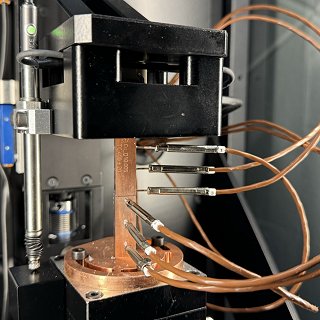 Here you can find out why effective thermal conductivity and bulk thermal conductivity can be completely different in practice, what role the contact resistance between the surfaces and the paste plays and how thermal compound can be measured precisely. There is also a detailed description of the equipment, the methodology and the error tolerances. Here you can find out why effective thermal conductivity and bulk thermal conductivity can be completely different in practice, what role the contact resistance between the surfaces and the paste plays and how thermal compound can be measured precisely. There is also a detailed description of the equipment, the methodology and the error tolerances. |
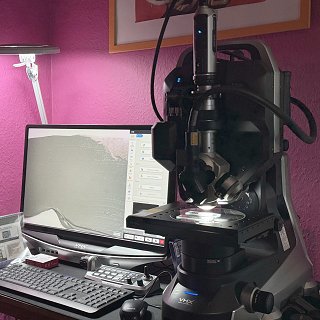 You will learn how laser-induced plasma spectroscopy works and the advantages and limitations of the measurements. There is also high-resolution digital microscopy and analysis of particle sizes. This information is also used to estimate the long-term stability of a paste. You will learn how laser-induced plasma spectroscopy works and the advantages and limitations of the measurements. There is also high-resolution digital microscopy and analysis of particle sizes. This information is also used to estimate the long-term stability of a paste. |
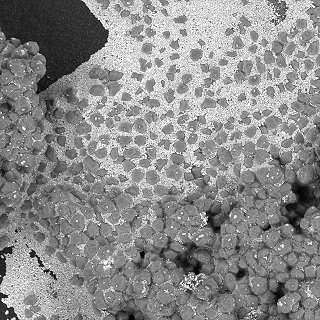 Anyone who has always wanted to know what is or is not in a paste and how these pastes are produced will find what they are looking for here. The basic article provides a better understanding of what is often sold for far too much money and sometimes with adventurous promises. Anyone who has always wanted to know what is or is not in a paste and how these pastes are produced will find what they are looking for here. The basic article provides a better understanding of what is often sold for far too much money and sometimes with adventurous promises. |















73 Antworten
Kommentar
Lade neue Kommentare
Veteran
1
Urgestein
1
Veteran
1
Urgestein
Veteran
Urgestein
1
Urgestein
1
Urgestein
1
Urgestein
1
Urgestein
Urgestein
1
Alle Kommentare lesen unter igor´sLAB Community →