















I’m deliberately starting this test at the beginning, because the question of the actual origin and quality of such phase change pads often determines the subsequent performance more than any manufacturer’s specifications. Thermal Grizzly offers the Phase Sheet PTM for just under 9 euros, a product that clearly falls into the same category as the much-cited Honeywell PTM7950, but Honeywell in particular has had a fundamental problem for years. These pads never reach the end customer market via regular, traceable sales channels and instead appear via intermediaries, remnant sources or supposedly exclusively accessible dealers, where you can never be sure whether you are actually getting an original. In many cases, these are generic OEM products that have simply been labeled accordingly. Such products do not automatically have to be inferior, but they are not traceable, which ultimately makes any technical assessment more difficult.

If you want to rely on a reliable basis, the only option is to carry out your own measurements and a proper material analysis. This is exactly what I want to do for myself today, to find out whether the Phase Sheet PTM from Thermal Grizzly actually achieves a level of performance in practice that is comparable to the hyped Honeywell material. It has long been known that Thermal Grizzly does not produce the material itself but buys it in, but only a thorough investigation will show what is actually on offer here and how the product can be classified technically.
Incidentally, the term phase change pad is completely misleading in German because it suggests that a complete change of aggregate state takes place. However, this is precisely not the case. The correct technical term is phase transition material, often abbreviated as PTM. This describes a material that changes its internal structure within a defined temperature window without changing from a liquid to a solid state in the classic sense. Rather, it is a transition within the same phase in which the viscosity decreases significantly and the material becomes more flowable under pressure. This transition improves the wetting of the surfaces, leads to a more homogeneous layer and thus lowers the thermal contact resistance without the material running out completely like a liquid or changing its shape, as would be expected in a real phase change.
 |
 |
A simple example is a buckling heat pad for a trouser pocket, in which a supersaturated sodium acetate crystal suddenly changes to a metastable liquid state, releasing heat in the process. The pillow undergoes a real phase change from a solid to a liquid state, which can be felt through the heat of crystallization. PTMs for the electronics sector work completely differently. They do not melt, they do not liquefy and they do not release any heat of crystallization. They merely change their internal order, which makes them more plastic when warm and better able to adapt to microscopic irregularities. This also explains why the term phase change pad is not technically correct, although it has become commonplace in everyday life. The difference between a real phase change and a phase transition is therefore not just linguistic, but describes a fundamentally different physical behavior that also determines the practical application.
What comes out of the grab bag?
The entire packaging of the Phase Sheet PTM presents itself as a set deliberately designed for end customers. The resealable main bag contains a separate, small cardboard box that serves to protect the actual pad. This inner cardboard box has a stable structure that reliably absorbs transport pressure. Inside, two precisely fitting foam inserts hold the pad securely in position so that it cannot slip or become unintentionally deformed. The outer bag is functional and large enough to hold the case without tension. The enclosed operating instructions are written in several languages. It describes how to use the material briefly but clearly and refers to further information via a QR code. The design of the booklet corresponds to that of the manufacturer’s other products and focuses exclusively on correct use, without providing any further technical details.

The actual pad is located in the padded inner carrier and is covered with protective film on both sides. These films have a slight protrusion at one corner, which serves as a practical offset for removal. As the material has a tough and slightly rubbery consistency, this protrusion makes it much easier to remove the films and prevents the pad from being damaged or deformed when it is lifted. The pad itself is smooth, homogeneous and cleanly manufactured, which at least visually suggests controlled production quality.

There is no officially published technical data on this product, neither on conductivity nor on the optimum operating temperature or the composition of the material. The manufacturer does not provide any information on this, meaning that a reliable technical classification is only possible using the manufacturer’s own measurement data. It is precisely these measured values that form the basis of the following analysis, as only they allow a comprehensible and reproducible evaluation of the phase sheet offered.
| Property | Specification according to packaging |
|---|---|
| Model | TG Phase Sheet PTM |
| Thermal conductivity (measurement) | > 6.5 W/m-K (melted at 22 µm) |
| Thermal resistance (measurement) | 0.04801 W/K (melted at 22 µm) |
| Color | Gray |
| Melting point Begin | 40 °C |
| Melting point high | 50 °C |
| Melting point end | 55 °C |
| Thickness (measurement) of the unmelted pad | 0.225 mm (225 µm) |
| Minimum thickness after burn-in | 22 µm |
| Electrical conductivity | non-conductive |
A precise representation of the burn-in behavior was only made possible by a modification of the TIMA5, which two colleagues from Nanotest carried out here in the laboratory. Since then, the drift of the thickness measurement has remained within a window of no more than around two micrometers between the lowest and highest measurement levels, even at the required temperatures and the selected test pressure, which allows a much more reliable evaluation. There will be a separate, detailed article on these changes and the associated improvements for the database.
It should therefore be noted that there is already a considerable gap between the advertising promises and the physical reality. And that is precisely why we need to measure the whole thing now!
| Material analysis and microscopy | Basic knowledge | |
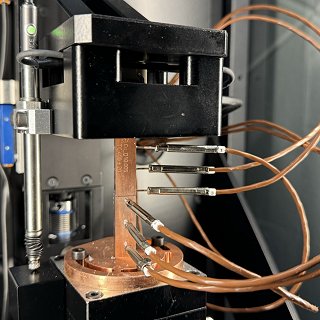 Here you can find out why effective thermal conductivity and bulk thermal conductivity can be completely different in practice, what role the contact resistance between the surfaces and the paste plays and how thermal paste can be measured accurately. There is also a detailed description of the equipment, the methodology and the error tolerances. Here you can find out why effective thermal conductivity and bulk thermal conductivity can be completely different in practice, what role the contact resistance between the surfaces and the paste plays and how thermal paste can be measured accurately. There is also a detailed description of the equipment, the methodology and the error tolerances. |
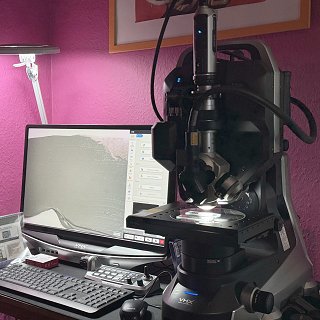 You will learn how laser-induced plasma spectroscopy works and the advantages and limitations of the measurements. There is also high-resolution digital microscopy and analysis of particle sizes. This information is also used to estimate the long-term stability of a paste. You will learn how laser-induced plasma spectroscopy works and the advantages and limitations of the measurements. There is also high-resolution digital microscopy and analysis of particle sizes. This information is also used to estimate the long-term stability of a paste. |
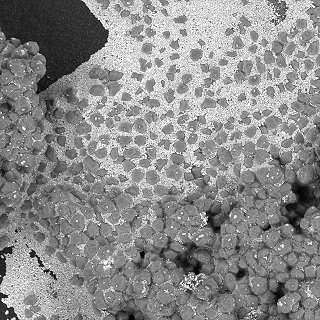 Anyone who has always wanted to know what is or is not in a paste and how these pastes are produced will find what they are looking for here. The basic article provides a better understanding of what is often sold for far too much money and sometimes with adventurous promises. Anyone who has always wanted to know what is or is not in a paste and how these pastes are produced will find what they are looking for here. The basic article provides a better understanding of what is often sold for far too much money and sometimes with adventurous promises. |

Thermal Grizzly PhaseSheet PTM, Wärmeleitpad (TG-PS-50-40)
 | Lagernd, Lieferung 1-2 WerktageStand: 23.12.25 07:25 | 9,13 €*Stand: 23.12.25 07:30 |
 | Lieferzeit ca. 1-3 Werktage | 9,14 €*Stand: 23.12.25 03:49 |
 | Lagernd, Lieferzeit 1-3 Werktage | 9,69 €*Stand: 23.12.25 07:04 |












41 Antworten
Kommentar
Lade neue Kommentare
Mitglied
Veteran
1
1
Mitglied
Urgestein
Urgestein
Urgestein
1
1
Urgestein
Urgestein
1
Veteran
Urgestein
Veteran
Mitglied
Veteran
1
Alle Kommentare lesen unter igor´sLAB Community →