















The KoolFaze 918 from ZYP Coating is a good example of how even experienced specialists in their own field can fail if they underestimate the complex interrelationships of a different specialist area. The company is actually considered a proven expert in high-temperature coatings and ceramic protection systems, but the development of a heat-conducting paste follows completely different physical laws. Anyone who believes that with a little knowledge of materials and chemical skills they will suddenly be able to develop a competitive paste will soon be proven wrong. There is a world of difference between the romance of an artisan inventor, the stroke of luck of a chance combination of materials and targeted research refined over years with extensive laboratory series.

This is precisely why today’s test is more than just a technical examination of a product, but a warning example of how quickly the line between ambition and arrogance is crossed. It shows that in this market segment, neither the best marketing idea nor the best-sounding brand name are enough when physical reality dictates its own rules. The KoolFaze 918 is therefore not just a paste for measuring, but a lesson in how much looks simpler than it actually is – and that promises without a sound technical basis often fizzle out faster than they are made.
Boron nitride, often referred to as hexagonal boron nitride or h-BN, is considered a valuable material in many technical areas. Its high temperature resistance, electrical insulation and good chemical stability make it almost indispensable in the coatings and ceramics industry. These properties tempt many manufacturers to use boron nitride as the basis for heat-conducting pastes, as the material has considerable thermal conductivity, at least in its pure, crystalline form and under optimum conditions. However, this is where the misunderstanding begins.

The thermal conductivity in pastes does not depend solely on the theoretical conductivity of a filler, but just as much on its particle size, shape, surface properties and, above all, its embedding in the carrier medium. Boron nitride particles are usually platelet-shaped and tend to cross-link poorly. This results in tiny air pockets in the binder, which drastically impair heat transfer. While the material still shines in a sintered ceramic, its potential often fizzles out ineffectively in a viscous paste. Keyword interface resistance, because I’ll come back to that in a moment.
Many companies underestimate this fact, especially if they produce boron nitride as a raw material or coating component anyway. The obvious idea is to simply recycle the existing material and thus open up a new product segment. However, this is precisely where it becomes clear that the transfer of expertise from the core business to a completely different application rarely works smoothly. The path from the supposedly logical step to the actual misguided development is often shorter than you might think. Or, to put it bluntly: in this case, it is only a very small step from core business to meltdown.
What you get: Marketing á la carte
The marketing claims for KoolFaze 918 from ZYP Coatings sound impressive at first and make targeted use of the key terms that have been considered sales-promoting in the thermal compound industry for years: high thermal conductivity, electrical insulation, chemical stability and long shelf life. However, a closer look reveals clear discrepancies between the advertising and the physical realities that are relevant for a functioning heat transfer between silicon and the heat sink.
 |
 |
ZYP Coatings advertises with an “advanced mixture” of boron nitride, aluminum oxide and graphite. This combination may seem interesting in theory because it combines components that have different thermal conductivities and electrical properties when considered individually. In practice, however, the question arises as to the homogeneity and interface adaptation of these particles in the carrier medium. Boron nitride is platelet-shaped, hydrophobic and difficult to match with the binders typically used in paste formulations. Aluminum oxide is chemically stable but thermally comparatively inert, and graphite tends to segregate if the viscosity of the system is not precisely controlled. Such a triple mixture is therefore not a step forward per se, but involves considerable risks for the uniformity of the layer and effective heat transfer.
However, the manufacturer’s claim of a thermal conductivity of “10.2 W/m-K (calculated estimate)” deserves special attention. The wording “calculated estimate” alone shows that this is not a measured value relevant in practice, but a theoretical calculation based on the individual components. In real measurement setups, especially under the conditions of a typical CPU or GPU surface with a rough surface and minimal layer thickness, the effective value is likely to be significantly lower, often in the range of 1 to 2 W/m-K. This would put KoolFaze 918 far behind established pastes based on silicone oils or polymer carriers with highly dispersed oxides or silicon compounds. The claim of optimum stability and long durability can also be viewed critically. Boron nitride-based systems have a pronounced tendency to dry out under varying thermal loads, as many formulations are based on solvents or low-viscosity carriers that outgas or settle when heated. The advertised temperature window of -65 °C to 200 °C may be theoretically true, but is hardly relevant in electronic applications, as changes in consistency and contact resistance already occur at 100 to 120 °C.
 |
 |
The argument that silicones are not used in order to avoid “contamination of the components” is only positive at first glance. Silicone oils are used in industry for a reason: they offer excellent wetting, a low evaporation rate and very stable temperature behavior. It may make sense not to use them for high-vacuum applications, but in PC technology they usually lead to a disadvantage in terms of long-term performance. All in all, it can be said that the KoolFaze 918 mainly advertises with terms that suggest technological competence, but in application it is an immature mixture with no recognizable thermal advantage. What remains is an ambitious idea from a company that has overestimated its knowledge of materials and underestimated the requirements for a functioning thermal compound.
The following is a tabular summary of the advertised and realistically classifiable technical data:
| Property | Manufacturer’s specification | Technical assessment / reality |
|---|---|---|
| Main components | Boron nitride, aluminum oxide, graphite | correct information, but unfavorable combination with unclear particle distribution |
| Carrier medium | proprietary (not specified) | probably solvent or polymer based with limited stability |
| Color | Gray | plausible |
| Density | 1.37 g/cm³ | realistic, typical for oxide-based pastes |
| Thermal conductivity | 10.2 W/m-K (calculated) | practically rather 1-2 W/m-K, depending on application and pressure |
| Temperature range | -65 °C to 200 °C | upper limit unrealistic in continuous operation, risk of drying out from approx. 120 °C |
| Electrical conductivity | non-conductive | correct, as oxides and boron nitride are insulating |
| Shelf life | several years | theoretically possible, but depends on storage conditions |
| Viscosity | pasty | correct, but possibly too fluid for even application |
| Special feature according to advertising | no silicones, non-flammable, non-corrosive | technically correct, but with disadvantages in terms of wetting and long-term stability |
It should therefore be noted that there is already a considerable gap between the elaborately formulated advertising promises and the physical reality. The product shows that the transition from high-temperature coating to efficient thermal interface is not a simple change of sides, but that there is a fundamental difference in mechanisms, material physics and practical application. And that is precisely why we need to measure the whole thing now!
| Material analysis and microscopy | Basic knowledge | |
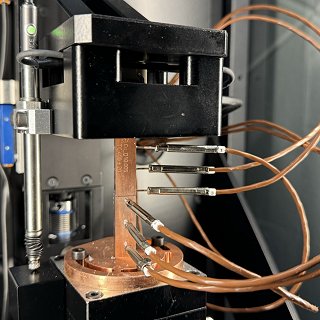 Here you can find out why effective thermal conductivity and bulk thermal conductivity can be completely different in practice, what role the contact resistance between the surfaces and the paste plays and how thermal paste can be measured accurately. There is also a detailed description of the equipment, the methodology and the error tolerances. Here you can find out why effective thermal conductivity and bulk thermal conductivity can be completely different in practice, what role the contact resistance between the surfaces and the paste plays and how thermal paste can be measured accurately. There is also a detailed description of the equipment, the methodology and the error tolerances. |
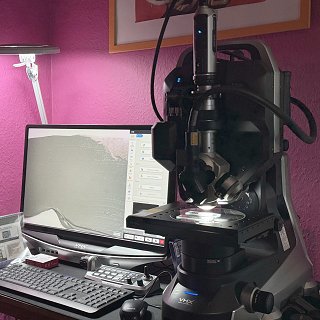 You will learn how laser-induced plasma spectroscopy works and the advantages and limitations of the measurements. There is also high-resolution digital microscopy and analysis of particle sizes. This information is also used to estimate the long-term stability of a paste. You will learn how laser-induced plasma spectroscopy works and the advantages and limitations of the measurements. There is also high-resolution digital microscopy and analysis of particle sizes. This information is also used to estimate the long-term stability of a paste. |
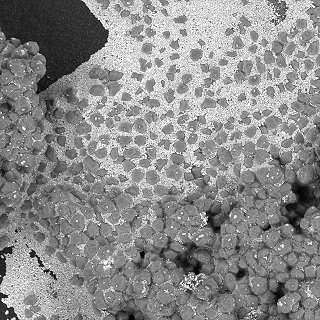 Anyone who has always wanted to know what is or is not in a paste and how these pastes are produced will find what they are looking for here. The basic article provides a better understanding of what is often sold for far too much money and sometimes with adventurous promises. Anyone who has always wanted to know what is or is not in a paste and how these pastes are produced will find what they are looking for here. The basic article provides a better understanding of what is often sold for far too much money and sometimes with adventurous promises. |



















15 Antworten
Kommentar
Lade neue Kommentare
Veteran
Veteran
Veteran
Veteran
Urgestein
Urgestein
Mitglied
Veteran
Urgestein
1
Veteran
Veteran
Veteran
1
Veteran
Alle Kommentare lesen unter igor´sLAB Community →