














Thermal paste database version 3.0
After extensive tests and detailed measurements, I have redefined and restructured the three search criteria and the evaluation of the thermal pastes. The aim of this adjustment is to better reflect the real performance, especially for very thin layer thicknesses below 30 µm, as this area is the most relevant in practice. In previous databases and manufacturer specifications, this critical range was often not sufficiently taken into account, although it is decisive in determining how efficiently a thermal compound actually works in real application scenarios. Depending on the selected range, an average value is therefore calculated from the actual, effective thermal resistance and used for subsequent sorting. However, all pastes are always displayed immediately, but sorted differently and adapted to the range.
| Preselection by layer thickness | |
| Smooth and even Surface |
The selection focuses exclusively on performance with layer thicknesses below 30 µm and clearly shows which pastes still perform well when applied extremely thinly. There are many contradictions here between nominal thermal conductivity values and real measurements, as filler distribution, viscosity and surface adaptation of the paste play a decisive role. Most manufacturers do not provide any specific data for this area, although it is precisely here that the thermal efficiency of a cooling system is significantly influenced. |
| Rough and uneven surface | This group refers to rather rough, curved or uneven surfaces, which occur in particular with certain CPU and GPU variants. These include CPUs in the LGA1700 socket, which place particular demands on the thermal paste due to their characteristic curvature, as well as very large monolithic GPU chips, whose surface structure also requires an adapted assessment. This segment measures how well a paste is able to ensure consistently effective heat transfer despite such unevenness. |
| Gap Filler |
This group ultimately forms an average performance value of the effective thermal conductivity across all possible layer thicknesses of a paste up to the upper limit of 400 µm. While most applications are in a significantly lower range, this group enables a holistic evaluation of the paste performance. |
| Help with the search result |
|
| Skills |
The traffic light rating from 1 to 5 is based on consistency, because the more viscous a paste is, the more difficult it is to apply correctly. Green stands for liquid to normal, yellow for slightly viscous and orange for viscous. This value has no influence on the sorting, but is only a statement in the table. |
| Sticky |
Sticks the desired paste and remembers it on all displayed pages. This allows you to compare a paste from page 1 with one on page 5, for example. |
| Selection field |
If two fields are selected, a 1:1 comparison of these two pastes is possible |
| Name |
Click on the manufacturer or the name of the paste to open the detailed individual test, including material analysis (ingredients) and microscopy (particle sizes) |
This database is constantly being expanded and new products added. It is therefore always worth visiting again. Please select one of the following three selection criteria to display the results or to compare the products:
Test setup, measurement methods and basics
Our database is based on real laboratory values that we have elaborately determined according to industry standards. However, many of these results contradict the manufacturers’ marketing claims and ruthlessly expose contradictions and lies, but they are all well-founded, reproducible and legally sound. These measurements not only reflect the general performance values of the pastes, but also enable an assessment of the suitability for a specific area of application (layer thicknesses, surfaces) as well as the suitability taking into account the individual capabilities of the respective user. In addition, the material analysis including digital microscopy is suitable for making your own assessment of the possible durability of a paste, even if I do not want to and cannot guarantee this. Unfortunately, measuring more than 3000 cycles per paste is not feasible. Statements about the matrix and the particles used, including their size, are also important. Please refer to my other articles and all individual tests on pastes that have shown certain abnormalities.
| Test setup and methods | Material analysis & microscopy | Basic knowledge |
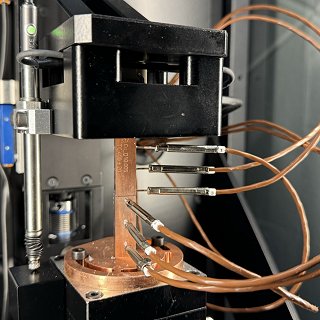 Here you can find out why effective thermal conductivity and bulk thermal conductivity can be completely different in practice, what role the contact resistance between the surfaces and the paste plays and how thermal compound can be measured precisely. There is also a detailed description of the equipment, the methodology and the error tolerances. Here you can find out why effective thermal conductivity and bulk thermal conductivity can be completely different in practice, what role the contact resistance between the surfaces and the paste plays and how thermal compound can be measured precisely. There is also a detailed description of the equipment, the methodology and the error tolerances. |
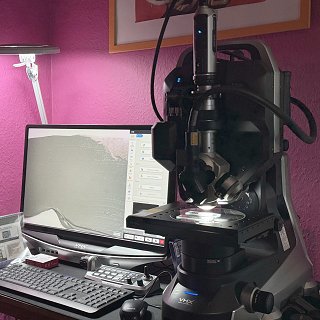 You will learn how laser-induced plasma spectroscopy works and the advantages and limitations of the measurements. There is also high-resolution digital microscopy and analysis of particle sizes. This information is also used to estimate the long-term stability of a paste. You will learn how laser-induced plasma spectroscopy works and the advantages and limitations of the measurements. There is also high-resolution digital microscopy and analysis of particle sizes. This information is also used to estimate the long-term stability of a paste. |
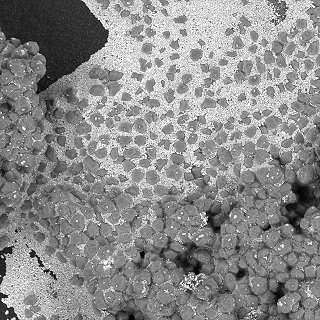 Anyone who has always wanted to know what is in a paste and what is not and how these pastes are produced will find what they are looking for here. The basic article is intended to give you a better understanding of what is often sold for far too much money and sometimes with adventurous promises. Anyone who has always wanted to know what is in a paste and what is not and how these pastes are produced will find what they are looking for here. The basic article is intended to give you a better understanding of what is often sold for far too much money and sometimes with adventurous promises. |
You are welcome to leave suggestions and comments in the forum, via PN or e-mail. If you would also like to contribute to the project and send me samples of thermal compound that have not yet been entered in the database, please contact me by e-mail. The e-mail address can be found in the imprint. Of course, this also applies to the manufacturers whose products we would like to test, regardless of which continent the product comes from. The scope of the database is de facto unlimited and as the methods and equipment are always the same, it can be expanded over the years and still remain comparable. That is the advantage over measurements on CPUs or GPUs and changing environmental conditions. And that is why I will continue to test and add new pastes and publish individual tests for interesting products. My very special thanks also go to my colleagues at Berlin-based Nanotest GmbH and Keyence for their expert advice and support to ensure that such a major investment pays off in the end.
Here are all the individual tests, basic and practical articles for you to read again:











18 Antworten
Kommentar
Lade neue Kommentare
Moderator
1
Neuling
1
Neuling
1
Neuling
1
Neuling
1
Neuling
1
Neuling
Neuling
1
Neuling
Mitglied
Mitglied
Alle Kommentare lesen unter igor´sLAB Community →