














Before we move on to another product test this afternoon, I have an interesting piece of consumer information to share this morning. I have added further technical details that the manufacturer did not mention in its press release, even though these aspects are likely to be of particular interest to a professional audience. The Chinese manufacturer Titan Army, whose products are the focus today, has long been established in Asia and is now increasingly trying to gain a foothold in the European market. With four new models, the company covers a broad spectrum ranging from affordable entry-level displays to ambitious Mini-LED flagships. What stands out is Titan Army’s consistent effort to integrate features normally found in higher price classes into more budget-friendly models. Titan Army is a brand of Shenzhen Century Joint Innovation Technology Co., Ltd., a Chinese company based in Shenzhen that has been active in the gaming monitor market for several years. This company, also known by the short name United Innovation, has specialized in developing and marketing its own branded display products instead of acting solely as a supplier for other brands.
Unlike traditional OEMs such as KTC, which mainly manufacture for international clients, Shenzhen Century Joint Innovation positions itself with Titan Army directly as a brand vendor. The company follows a dual strategy: on the one hand, it sells heavily in China through online platforms and livestreaming, and on the other hand, it has recently begun using international platforms such as Amazon and Geekbuying to reach markets outside of Asia. This strategy is typical of a number of Chinese manufacturers that first establish themselves in their domestic market and then enter international competition with aggressive pricing and eye-catching technical features in order to quickly gain market share. Titan Army focuses particularly on the gaming sector, where features such as dual-mode operation or DyDs Mini-LED control are emphasized as technological differentiators.
The strategy is clearly aimed at aggressive pricing and rapid market penetration. While comparable Mini-LED models from established manufacturers often cost well over 600 euros, Titan Army offers its flagship P275MV Plus for around 380 euros. This pricing approach is reminiscent of the market entry of Chinese smartphone brands, which first established themselves with inexpensive but technically strong devices. Distribution through Amazon in Europe provides consumers with return security and forces Titan Army to maintain a certain level of service. This makes the brand an intriguing new player in the gaming monitor segment.
Titan Army P2712V – flexibility through dual mode
The P2712V is a 27-inch monitor that offers a special feature: Users can switch between two operating modes. Users can either use the native 4K resolution at 160 Hz or switch to Full HD and achieve frame rates of up to 320 Hz. This makes the device suitable for both competitive e-sports gaming and detail-oriented 4K titles. The panel is based on Fast IPS technology, which combines short response times with good color reproduction. This so-called Dual Mode used by Titan Army in the P2712V and P275MV Plus is, from a technical perspective, a combination of panel overdrive, adaptive clocking of the timing controller (TCON), and flexible control of the scaler and signal processing unit. Normally, LCD panels are designed for a fixed combination of resolution and refresh rate. Here, instead, a dual operating mode is implemented that allows for different signal paths and timing schemes. In 4K mode, the panel operates at its native resolution of 3840 × 2160 and achieves refresh rates of up to 160 Hz. For this, the internal TCON runs at very high bandwidth, typically via DisplayPort 1.4 or HDMI 2.1 with DSC (Display Stream Compression). Signal processing follows the conventional raster approach, with all subpixels addressed and full color interpolation applied.
In Full HD mode, the panel is driven in a reduced addressing scheme. There are generally two approaches: either subpixels are electronically grouped so that four native pixels form one image point, or the TCON operates in a “skipping mode,” where only every second addressing cycle is used. This reduces the effective resolution to 1920 × 1080, with physical pixels being reused multiple times. The advantage is that the panel’s data rate drops significantly, enabling refresh rates of up to 320 Hz. The key point is that Titan Army doesn’t just rely on upscaling within the scaler chip—which would simply stretch a 1080p signal to 4K—but instead drives the panel at a genuinely lower addressed resolution. This reduces latency, increases achievable frame rates, and lightens the load on signal processing. For users, it provides a real choice between detailed 4K rendering and maximum motion performance in Full HD. One small drawback of this technique is that image sharpness in 1080p mode is not as clean as on a native Full HD panel, since the physical subpixel structure is still optimized for 4K. However, the approach allows the monitor to cover two distinct usage scenarios in one device: 4K for graphics-rich story-driven titles, and Full HD with ultra-high refresh rates for e-sports and fast-paced shooters.
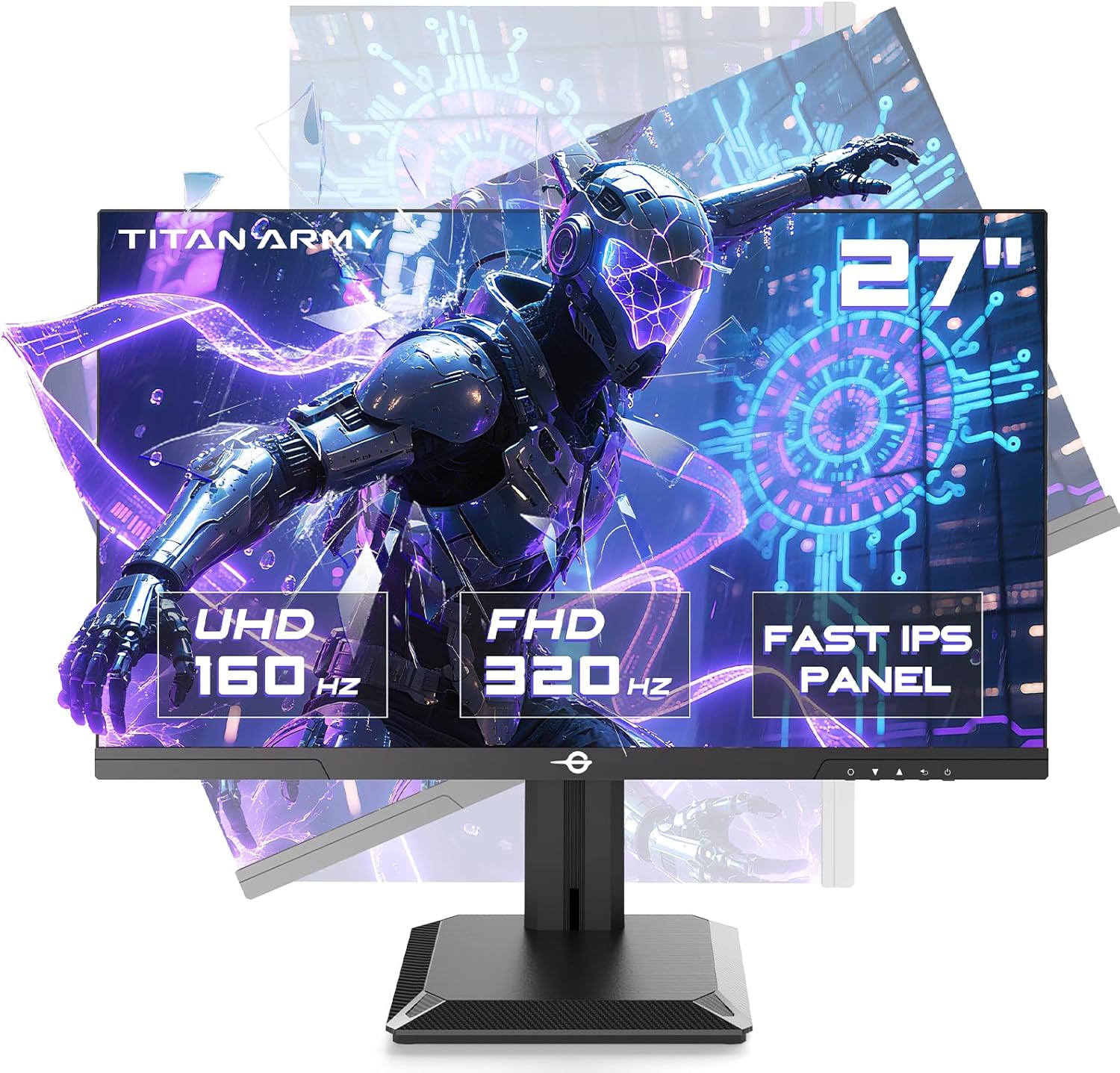
| Feature | Specification |
|---|---|
| Display size | 27 inch |
| Panel type | Fast-IPS |
| Resolution | 3840×2160 (4K) @160 Hz or 1920×1080 @320 Hz |
| Color space | approx. 135 % sRGB, 95 % DCI-P3 |
| Color depth | 8-bit FRC, 1.07 billion colors |
| HDR support | HDR400 |
| Adaptive Sync | yes |
| Special features | Dynamic OD, twelve predefined scenarios, PiP/PbP |
| Connections | 2× HDMI 2.1, 2× DP 1.4, USB-C, audio |
| Ergonomics | Height, tilt, swivel, pivot, VESA 100×100 |
| Price (Amazon) | 265.99 € with 5 % discount(link) |
Titan Army P275MV Plus – mini LED with DyDs technology
The real highlight is the P275MV Plus, which relies on full mini-LED backlighting. Thanks to 1152 dimming zones, the monitor achieves high contrasts and a maximum brightness of up to 1000 cd/m², which makes HDR content appear much more vivid. Titan Army combines this with its proprietary DyDs technology, which reduces backlight and display latency, improves motion display and optimizes visibility in dark scenes. DyDs is essentially an evolution of conventional local dimming and backlight scanning techniques found in modern Mini-LED monitors. While traditional systems control a fixed number of dimming zones that react to brightness changes with a certain latency, DyDs introduces tighter synchronization between panel driving and backlight operation. Instead of only adjusting zones based on brightness values, the control is performed line by line and section by section in an algorithmic sequence that links the video signal more closely to the timing of the LED drivers. This reduces backlight latency, meaning the delay between the panel receiving an input signal and the actual response of the backlight. Such latency is a weakness in many local dimming systems, since it can cause trailing effects in fast-moving scenes. By adjusting the Mini-LEDs in shorter intervals, DyDs effectively creates a form of linear scanning. The result is improved motion rendering, sharper edges during quick pans, and reduced smearing.
Another aspect is contrast optimization. DyDs applies a PQ curve tailored to the scene profile. Titan Army highlights presets for shooters, MOBAs, or AAA titles, each with different weightings between shadow detail, peak brightness, and color saturation. The so-called “Black Hole Vision” mode is designed to preserve detail in very dark gaming scenes without excessively raising the black level. Unlike standard FALD, which often produces abrupt shifts between light and dark, DyDs uses dynamic transitions and shorter control intervals to achieve a smoother image. The system also incorporates a kind of flash wake-up mechanism. This ensures that sudden brightness peaks—such as muzzle flashes or explosions—are represented more quickly, without being softened by the sluggish response of the backlight. Technically, this resembles a combination of local dimming and backlight scanning, extended by software-based scene analysis. In summary, DyDs addresses the known drawbacks of Mini-LED systems—particularly backlight sluggishness and imprecise dimming in dark scenes—by making control more granular and tightly synchronized with the video signal. The goal is to deliver an image experience that comes closer to OLED, without having to accept OLED’s weaknesses such as burn-in.
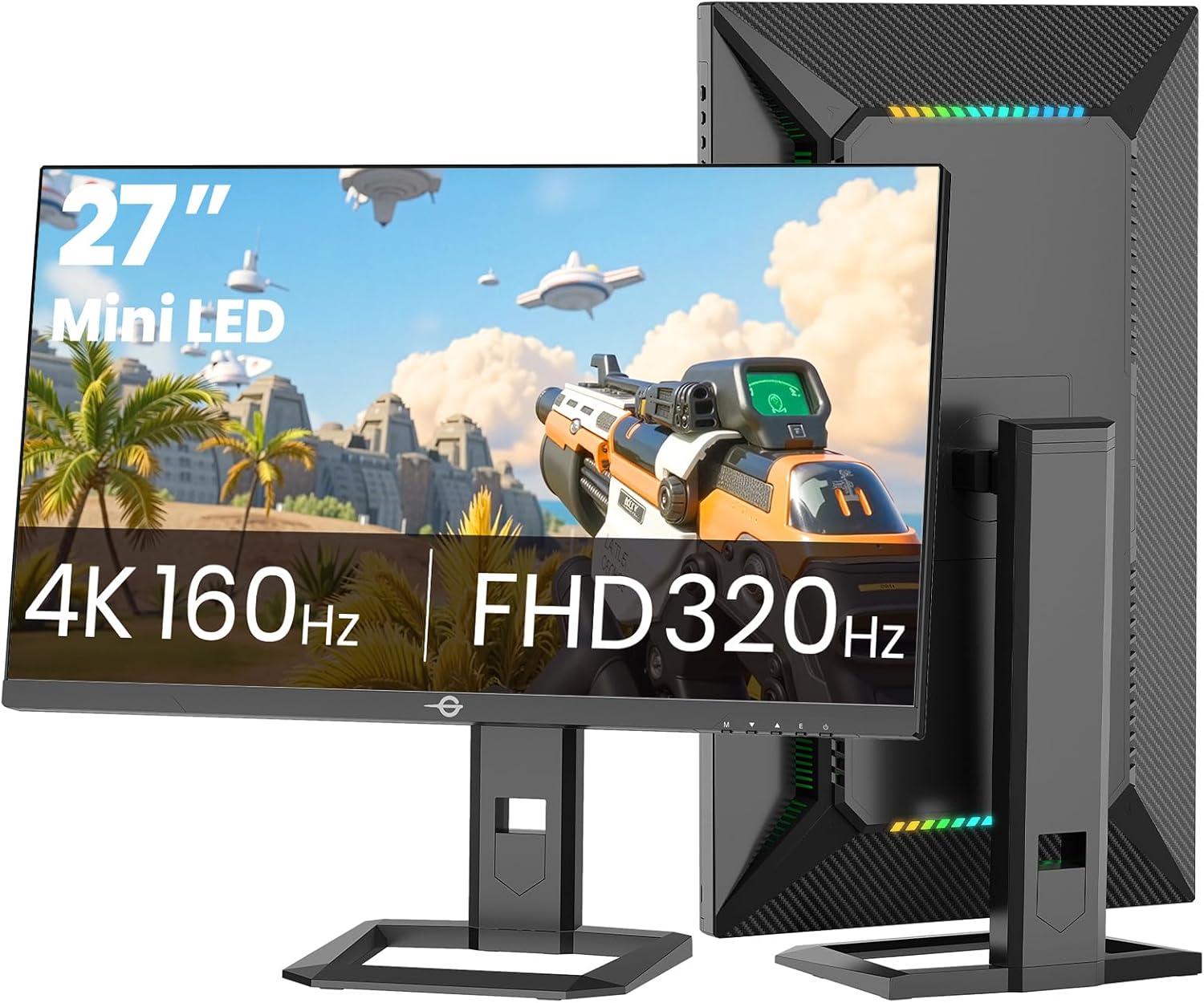
For gamers, this means fewer streaks during fast movements, a more precise black display and an overall higher picture fidelity. With HDMI 2.1 and DisplayPort 1.4, the monitor is also equipped for the latest graphics cards and consoles.
| Feature | Display specification |
|---|---|
| Display size | 27 inch |
| Panel type | Fast-IPS with Mini-LED |
| Resolution | 3840×2160 @160 Hz or 1920×1080 @320 Hz |
| Local Dimming | 1152 zones |
| Brightness | up to 1000 cd/m² (HDR1000) |
| Color space | 99 % DCI-P3, 99 % sRGB, 95 % NTSC |
| Color depth | 8-bit FRC |
| Adaptive Sync | yes |
| Special features | DyDs algorithm, 15 scenario modes, PiP/PbP, Titan widget software |
| Connections | 2× HDMI 2.1, 2× DP 1.4, USB-C, USB hub, audio |
| Ergonomics | Height adjustment, swivel, pivot, VESA 100×100 |
| Price (Amazon) | 379,99 € 10 US-$ discount with code TITAN10NEW03(Link) |
Titan Army C24A1H and C27A1H – affordable entry-level solutions
The C24A1H and C27A1H are the budget-friendly models in Titan Army’s new series, clearly aimed at entry-level users or those with smaller budgets. Both feature curved VA panels with a 1500R curvature radius and deliver Full HD resolution at 1920 × 1080. The choice of this panel technology is deliberate, as VA panels (Vertical Alignment) are considered a good compromise between TN and IPS technology. They generally achieve much higher contrast levels than IPS panels, offer more consistent black reproduction, and provide greater color stability than TN displays when viewed directly. However, they can exhibit slight smearing in very fast motion sequences, which is partly compensated by high refresh rates and overdrive tuning.
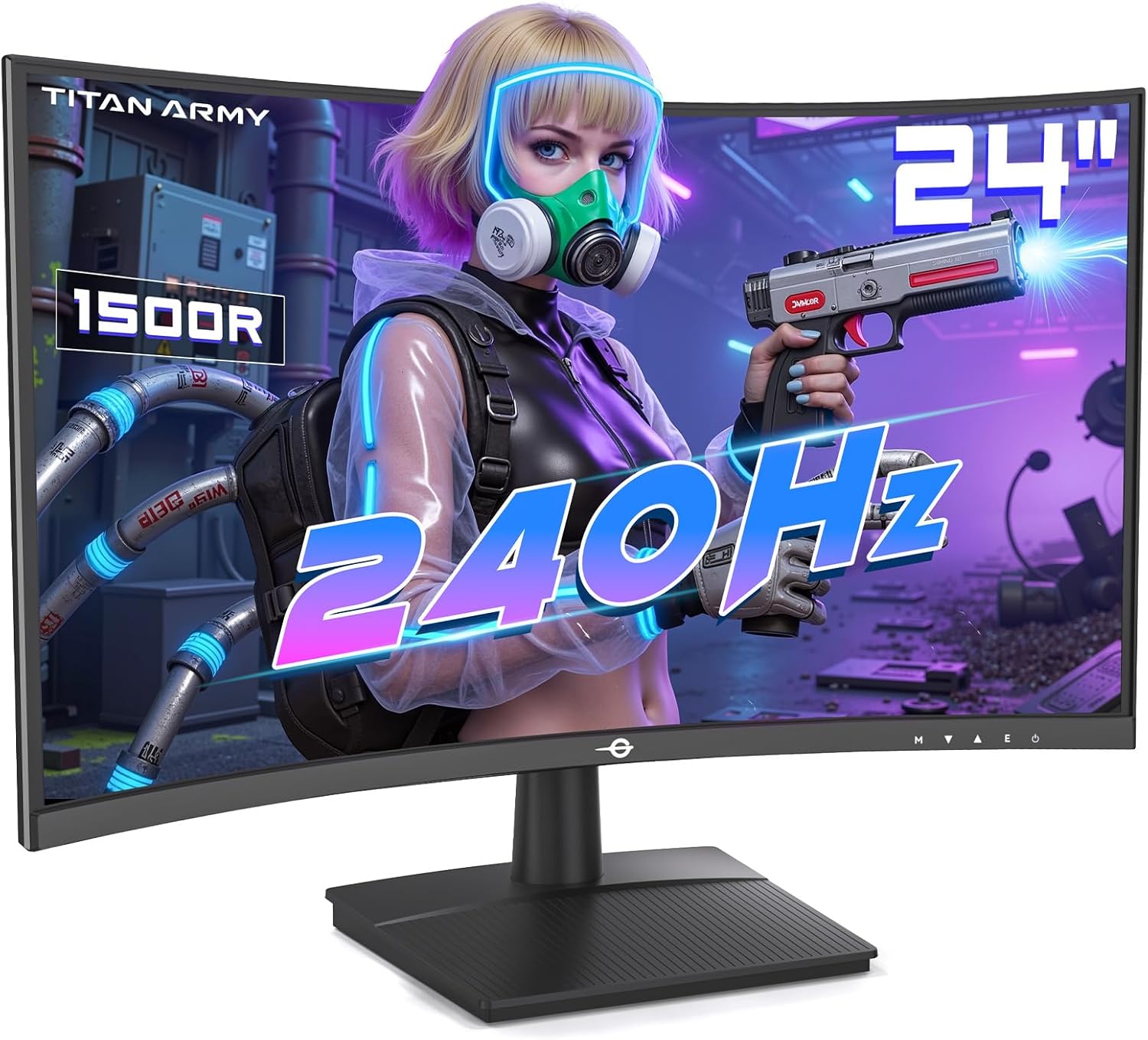
At 23.6 inches, the C24A1H is the more compact model. It supports refresh rates of up to 240 Hz and reaches a response time of about 1 millisecond MPRT. This makes it especially suitable for e-sports titles or fast-paced shooters where smoothness and low input lag are more important than maximum resolution. The panel also supports HDR10 and covers around 96 percent of the sRGB color space. The C27A1H takes it a step further with a 27-inch panel. It offers a maximum refresh rate of up to 300 Hz, combined with a response time of 1 millisecond GtG. Typical brightness is around 300 cd/m², the static contrast ratio reaches up to 4000:1, and the panel covers 99 percent of the sRGB color gamut.
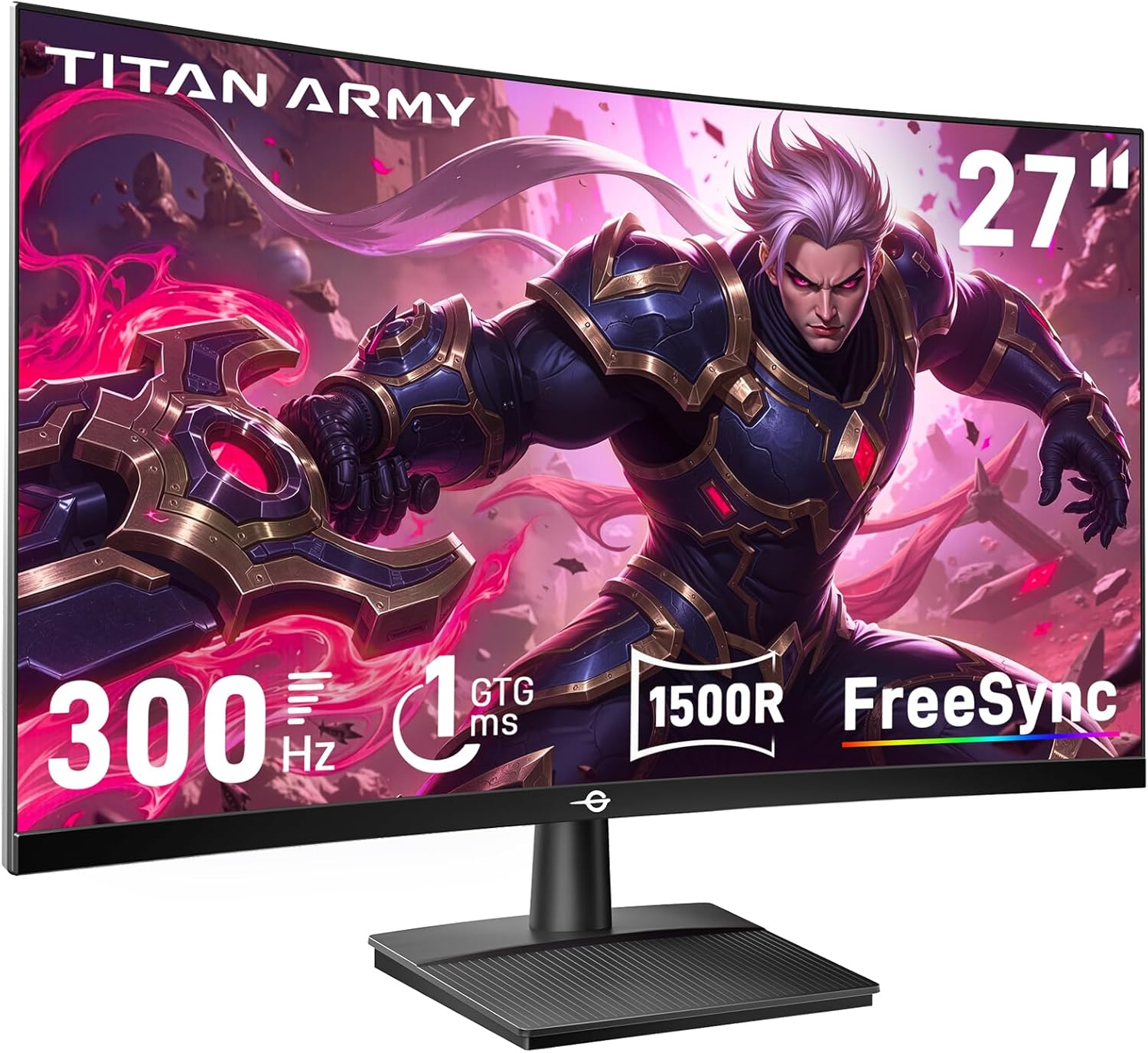
This monitor also supports HDR10. For gamers, this translates into an even faster display, particularly valuable in highly competitive scenarios. While neither model offers high-end technologies such as Mini-LED or 4K resolution, they still stand out with very high refresh rates, solid contrast performance, and an immersive curved design. This makes them especially attractive for users seeking smooth Full HD gameplay at an affordable price.
| Feature | C24A1H | C27A1H |
|---|---|---|
| Display size | 24 inch, curved | 27 inch, curved |
| Resolution | 1920×1080 | 1920×1080 |
| Refresh rate | 75-100 Hz (depending on model) | 75-100 Hz |
| Panel type | VA | VA |
| Connections | HDMI, VGA, Audio | HDMI, VGA, Audio |
| Price (Amazon) | 119,99 €(Link) | 149,99 €(Link) |
Editorial assessment
Titan Army covers an unusually broad spectrum with this series. The two dual-mode monitors with 4K/160 Hz and 1080p/320 Hz are particularly exciting, as they combine two usage scenarios in one device. This is a flexible solution for gamers who want to enjoy both fast-paced e-sports titles and visually demanding AAA games. With its mini LED backlight and DyDs technology, the P275MV Plus even sets accents that are otherwise only seen on significantly more expensive devices from established brands. The entry-level models C24A1H and C27A1H, on the other hand, are more pragmatic options that essentially provide an affordable overall package for Full HD gaming and everyday use. All in all, this product launch shows that Titan Army wants to establish its own brand in Europe as well – and with a price-performance ratio that should make many buyers curious.
| Model | Display size | Panel type | Resolution & frame rate | Color space / color depth | HDR | Brightness | Adaptive Sync | Special features | Connections | Ergonomics | Price (Amazon) |
|---|---|---|---|---|---|---|---|---|---|---|---|
| P2712V | 27 inch | Fast-IPS | 4K @160 Hz or FHD @320 Hz | 135 % sRGB, 95 % DCI-P3, 8-bit FRC | HDR400 | – | Yes | Dynamic OD, 12 scenarios, PiP/PbP | 2× HDMI 2.1, 2× DP 1.4, USB-C, Audio | Height, tilt, pivot, VESA 100×100 | 279,99 € (discount coupon, link) |
| P275MV Plus | 27 inch | Fast-IPS Mini-LED | 4K @160 Hz or FHD @320 Hz | 99 % DCI-P3, 95 % NTSC, 8-bit FRC | HDR1000 | up to 1000 cd/m² | Yes | DyDs Tech, 1152 dimming zones, Titan widget | 2× HDMI 2.1, 2× DP 1.4, USB-C, USB hub, audio | Height, pivot, VESA 100×100 | 379,99 € (discount coupon, link) |
| C24A1H | 24 inch curved | VA | FHD (1920×1080) @75-100 Hz | Standard sRGB | – | – | – | Entry-level solution | HDMI, VGA, audio | Tilt, VESA | 119,99 € (Link) |
| C27A1H | 27 inch curved | VA | FHD (1920×1080) @75-100 Hz | Standard sRGB | – | – | – | Entry-level solution | HDMI, VGA, audio | Tilt, VESA | 149,99 € (Link) |
This article contains paid advertising by the manufacturer. However, the links to the products used in the article are not affiliate links, so igor’sLAB does not earn any money from them.













26 Antworten
Kommentar
Lade neue Kommentare
Veteran
1
Urgestein
Urgestein
Mitglied
Mitglied
1
Moderator
Urgestein
Mitglied
Mitglied
Urgestein
Mitglied
Mitglied
Urgestein
Urgestein
Mitglied
Mitglied
Mitglied
Alle Kommentare lesen unter igor´sLAB Community →