














AMD has taken a step that may seem unspectacular at first glance, but in practice can help determine the success or mediocrity of an entire CPU generation. The upcoming Zen 6 architecture has officially arrived in the GCC compiler. The initial “znver6” patch has been merged into the main branch of the GCC Git repository and will therefore be part of GCC 16.1, which is expected to be released between March and April 2026.
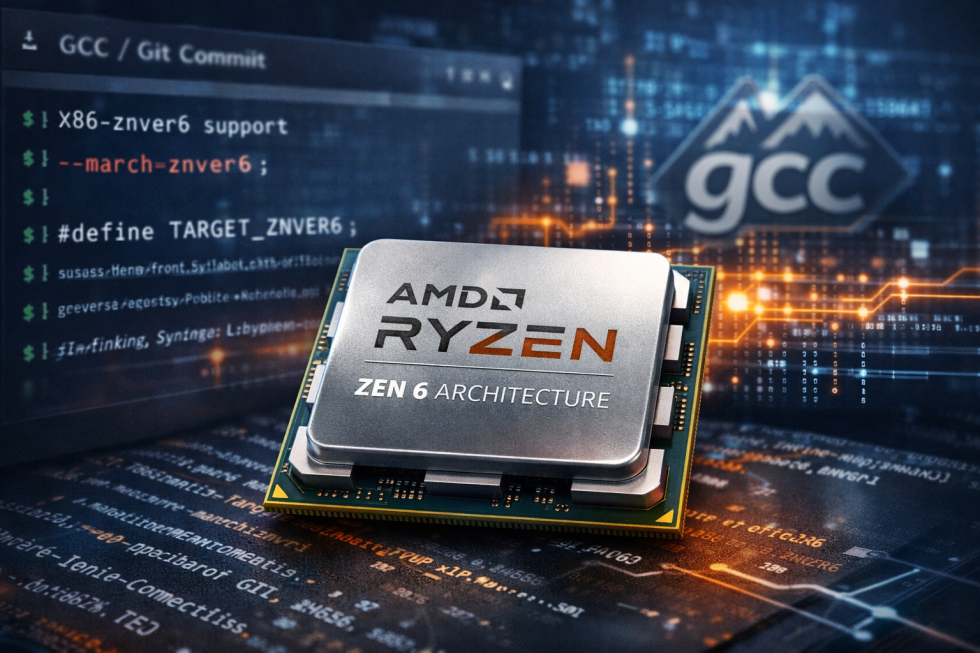
This is not a PR message, but infrastructure work. And this is where the theory and the real performance picture of modern CPUs diverge.
Why compiler support is crucial
A processor is only as good as the code it executes. Without targeted compiler support, applications may run functionally correctly, but they do not make optimum use of the pipeline structure, instruction mix or scheduling features. GCC plays a central role here, particularly in the Linux, server, cloud and HPC environment, but also indirectly in the desktop area, as large parts of the software toolchains are based on it.
The integration of znver6 gives GCC the ability to generate code specifically for Zen 6. This includes, among other things
- customized instruction selection
- optimized instruction scheduling
- Architecture-specific heuristics for register and cache utilization
- clean recognition of the CPU as an independent target, not just as a Zen 5 descendant
In short, Zen 6 is treated by the compiler for what it is – a new microarchitecture.
Timing is no coincidence
The timing is remarkable. Zen 6 will power both Ryzen CPUs for the consumer market and EPYC processors for data centers. The launch is expected in the second half of 2026. With GCC 16.1, basic support will therefore be available months in advance. Distributions such as Fedora, Ubuntu or SUSE can adapt their toolchains in good time, developers can prepare builds and benchmarks no longer run in “legacy mode”. AMD has clearly learned from previous generations here. With Zen 1 and Zen 2, compiler tuning was often delayed or fragmented. Intel, on the other hand, has maintained a close link between architecture planning and toolchain integration for years. Zen 6 shows this: AMD is now playing this game at eye level.
#AMD released the first official #Zen6 doc:
"Performance Monitor Counters for AMD Family 1Ah Model 50h-57h Processors" 69163 v1.00https://t.co/HQL86Hd7sW
Confirmed features:
PMCx003: #FP16
PMCx2C0: #MemoryProfiler
PMCx0AF: 6 Integer Scheduler (vs 1 central of #Zen5) pic.twitter.com/IA6lyexjvC— InstLatX64 (@InstLatX64) December 18, 2025
No miracles, but a foundation
A realistic classification is important. The current GCC merge is basic support, not performance fireworks. Fine details like:
- complete cost models
- aggressive auto-vectorizing
- Load/store optimizations
- precise latency and throughput parameters
will follow as soon as AMD releases more internal data or real silicon is available. This is normal. Compiler optimization is an iterative process, not a switch. Nevertheless, this step is crucial. Without it, there would inevitably be discussions at launch about “inexplicably low performance”, which in reality would have nothing to do with the hardware.
Strategic importance
This move is particularly relevant for the server market. EPYC customers compile large code bases themselves, often highly specialized. Early compiler support means faster adoption, less friction and better scaling from day one. In times when AMD is attacking Intel head-on in the data center, this is not a detail, but a competitive factor.
The bottom line is that Zen 6 is being developed not just as a chip, but as a platform. Whoever picks up compilers, operating systems and developers early on also controls the real performance perception in the end. AMD delivers here quietly but consistently.
No leak, no benchmark, no marketing slide would be more meaningful.
| Source | Key message | Link |
|---|---|---|
| Phoronix | Reports on the merge of the first AMD Zen 6 support “znver6” into the GCC Git tree and the planned integration in GCC 16.1. | https://www.phoronix.com/news/AMD-Zen-6-GCC-Znver6 |
| GCC Git Repository | Commit adds x86 processor support for AMD znver6 and forms the basis for compiler optimizations. | https://gcc.gnu.org/git/?p=gcc.git;a=commit;h= |
| Wccftech | Categorizes the GCC-16 integration of Zen 6 in time before the CPU launch and mentions effects on software optimization. | https://wccftech.com/amd-zen-6-support-added-gcc-16-ahead-of-launch/ |
























1 Antwort
Kommentar
Lade neue Kommentare
Veteran
Alle Kommentare lesen unter igor´sLAB Community →