














The global DRAM market has crossed a threshold where traditional market mechanisms are no longer sufficient. What previously looked like supply bottlenecks and long-term purchase agreements is now sliding into a much more unpleasant phase. Samsung is currently investigating its own employees for suspected bribery after evidence of bribes being paid to divert DRAM supplies emerged. The report comes from DigiTimes and shows how tense the situation has become.
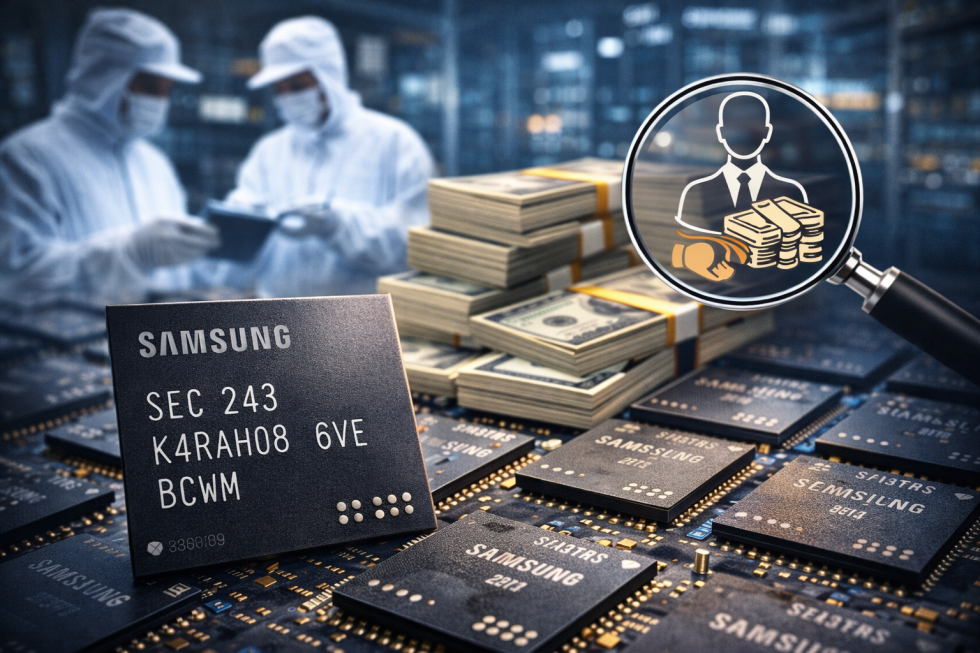
Specifically, it concerns Taiwanese distributors who, according to the report, are said to have paid so-called kickbacks to Samsung employees in order to gain preferential access to scarce DRAM quotas. Samsung did not respond with a formal PR statement, but with internal measures. According to reports, employee surveys are underway at the Taiwan site, accompanied by the prospect of disciplinary consequences. This fact alone shows that the company does not regard the allegations as a side note.
When even the market leader is running at the limit
The background is hardly surprising. DRAM is currently one of the toughest bottleneck factors in the entire IT industry. Hyperscalers, AI providers and server customers are securing capacity via long-term agreements, often for years. What remains is barely enough for smaller OEMs, board partners or distributors. This is precisely where the gray area arises, in which money apparently decides over allocation again. Samsung finds itself in a paradoxical situation. On the one hand, it is the largest memory manufacturer in the world, but on the other, it is under massive capacity pressure itself. Demand from data centers, AI clusters and high-end PCs significantly exceeds supply. Recently, this even led to Samsung reportedly rejecting a DRAM request from its own mobile division, simply due to a lack of available capacity. When even internal divisions come up empty-handed, it is clear how thin the air has become.
Kickbacks as a symptom, not the cause
The alleged kickbacks are not the cause, but a symptom. The market is so distorted that allocation has become a currency. Those who do not have a direct line to SK hynix, Samsung or Micron are looking for alternative ways. It was almost foreseeable that these would now apparently end up in areas relevant to criminal law. Samsung is less in the spotlight here as a perpetrator than as a gatekeeper of an overheated market. Internally, the issue is likely to be highly sensitive. Unregulated outflows not only jeopardize business relationships, but also strategic planning. At a time when prices are rising, supply chains are under scrutiny and regulators are already nervous, Samsung cannot afford a loss of trust. The investigation is therefore also a signal to major customers: Allocation should be controlled, not for sale.
No relief in sight in the short term
This does little to change the actual situation. The expansion of DRAM capacities takes quarters, not weeks. New production lines, yield optimization and packaging scaling take time. Until then, the market will remain tight, especially in the PC and consumer segment, where rising prices are already visible. Mainstream manufacturers have started to pass on these costs, while smaller players are increasingly being squeezed out of the market. The bottom line is that the case shows how fragile the current memory economy is. When employees of a global corporation become the target of bribery attempts, this is not an outlier, but a warning signal. DRAM is currently no longer a normal product, but a strategic commodity. And that is exactly how it is now being treated.
| Source | Key message | Link |
|---|---|---|
| DigiTimes | Reports on alleged kickback payments by Taiwanese distributors to Samsung employees for preferential DRAM allocation. | https://www.digitimes.com/news/a20251218PD201.html |
| Wccftech | Picks up on the report and places the bribery allegations in the global DRAM shortage. | https://wccftech.com/samsung-investigates-employees-taking-bribes-divert-dram-supply |
| Wccftech | Previously reported on Samsung’s rejection of a DRAM request from its own mobile division due to a lack of capacity. | https://wccftech.com/samsung-rejects-mobile-division-dram-supply-capacity-shortage |






















Bisher keine Kommentare
Kommentar
Lade neue Kommentare
Artikel-Butler
Alle Kommentare lesen unter igor´sLAB Community →