














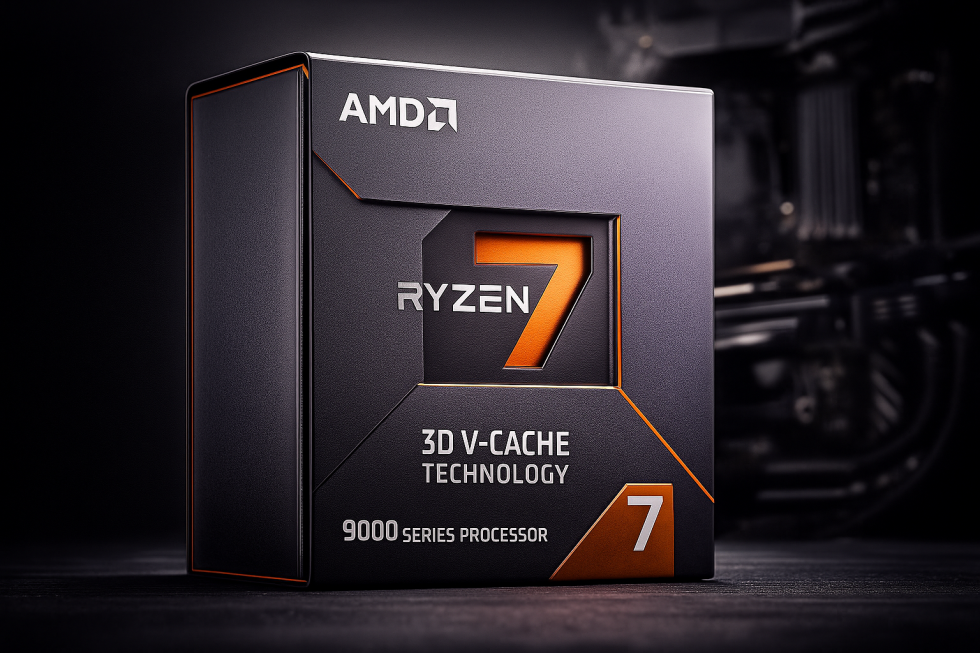
The Ryzen 7 9850X3D is currently a semi-official CPU. AMD has indirectly confirmed the name itself, but without publishing any technical details. This is based on an entry on AMD’s official driver and support page, which briefly referenced a separate subpage for the Ryzen 7 9850X3D within the Ryzen 9000 family. This discovery was first picked up by leak accounts on X and subsequently by specialist media such as PC Games Hardware, GameGPU and others, who unanimously report that this support entry effectively confirms the existence of the refresh, even if it was only a placeholder in terms of content. In parallel, there has been a consistent set of leaks since October, mainly due to the leaker Chi11eddog. WCCFtech, general hardware portals, price and key sites as well as retailer blogs quote almost identical key data and explicitly refer to this origin.
Technical classification and expected specifications
According to consistent leaks, the Ryzen 7 9850X3D is another eight-core with sixteen threads based on Zen 5, i.e. a single CCD design of the Granite Ridge generation for the AM5 socket. Like the Ryzen 7 9800X3D, the CPU should offer a total of 96 megabytes of L3 cache, consisting of a regular 32-megabyte L3 and an additional 64-megabyte 3D-V cache. The default TDP is consistently stated as 120 watts, which corresponds exactly to the thermal classification of the 9800X3D, the main difference lies in the clock frequency. Several sources unanimously state a maximum boost clock of up to 5.6 gigahertz. This corresponds to an increase of around four hundred megahertz compared to the officially documented Ryzen 7 9800X3D, whose boost is 5.2 gigahertz. The leaks thus reveal a pure clock refresh with an unchanged core and cache structure.
Architecturally, the 9850X3D remains within the familiar Zen 5 framework. Granite Ridge uses TSMC’s N4 manufacturing process, a modernized front end, improved bandwidths in L1 and L2 and a revised jump prediction without changing the basic chiplet structure compared to Zen 4. The stacked 3D V-cache of the current generation is less restrictive in terms of voltage and maximum clock, allowing X3D models to run at higher frequencies than the first generation around 5800X3D and 7800X3D. In this technical logic, a 9800X3D with a higher boost clock is a plausible step. The following table summarizes the specifications known to date:
| Feature | Ryzen 7 9850X3D |
|---|---|
| Architecture | Zen 5 |
| Cores / Threads | 8 / 16 |
| Clock frequency (max.) | Up to 5.6 GHz |
| L3 cache | 96 MB (3D V-Cache, 1 CCD) |
| TDP | 120 watts |
| Platform | AM5 |
| V-Cache generation | 2. Generation |
| Overclocking | Probably possible |
Role in the portfolio and competitive situation
In the current AM5 portfolio, the Ryzen 9000 models cover the spectrum from six to sixteen cores, supplemented by X3D variants for gamers, where the focus is clearly on cache latency and gaming throughput. The Ryzen 7 9800X3D is already positioned as the central gaming sweet spot, as many titles scale particularly well on a fast eight-core with a large L3 cache. The 9850X3D would likely extend this role upwards. According to the available reports, it would be a more highly selected 9800X3D with more aggressively tuned clock rates but an unchanged TDP. For users, this would ideally result in measurable added value in the CPU limit without having to adapt the platform or cooling solution. International reporting therefore describes the 9850X3D as a performance-optimized evolution of the 9800X3D, not as a new architecture.
In competition with Intel’s Arrow Lake CPUs, such an eight-core refresh is strategically interesting for AMD. While the 9800X3D already offers strong gaming performance, a nomenclaturally new model and slightly higher clock speed can easily generate headlines for the “faster X3D variant” without incurring the development and manufacturing costs of a completely new generation. Various articles therefore classify the 9850X3D as a building block of a broader X3D refresh, which also includes the Ryzen 9 9950X3D2 with dual 3D-V cache. This strategic interpretation is entirely plausible.
Several sources are talking about an X3D refresh of the Ryzen 9000 family, which could be linked to CES in early 2026. The Ryzen 9 9950X3D2 and the Ryzen 7 9850X3D are jointly mentioned here as a supplement for the gaming segment. There are no price details, only a high-end target audience is assumed. The specific AMD support entry appeared shortly before this expected period. It is logical that such a CPU is already created in the backend of the support and download portals, as product strings, filters and driver paths have to be maintained and tested in advance. Media outlets such as PC Games Hardware and GameGPU see the appearance of this entry as confirmation that the launch is imminent, but do not provide any fixed dates themselves. I can’t give an exact date or an officially communicated framework at the moment, so I can only say that a launch around CES is obvious, but not certain.
Possible motives why AMD is now “leaking” the 9850X3D
At this point, it is important to make a clear distinction between facts and speculation. First of all, the nature of the leak seems typical of a “controlled accident”. The entry appears on an official AMD page, but remains technically non-binding as no specifications are listed. From a manufacturer’s point of view, it is economically justifiable for such information to be leaked in advance in the course of system tests, as it also serves as a signal to enthusiasts that a new model is in the pipeline. This can create a certain reluctance to buy without formally devaluing the current product range.
Secondly, AMD is in a transition phase. Zen 5 has been introduced, Zen 6 is already promised in roadmaps and public statements for 2026. A late-launched 9850X3D can fill this gap by keeping the existing AM5 ecosystem attractive and giving both new and upgrade customers a reason to stick with the platform. The 9950X3D2 leaks reinforce this picture of a more cost-effective refresh based on existing dies with better binning.
Thirdly, it is noticeable that reports about the 9850X3D coincide with discussions about security updates for Zen 5 CPUs, problems at individual board manufacturers in connection with 9800X3D failures and the growing number of X3D offshoots. It stands to reason that AMD would like to draw additional attention to the gaming flagship on AM5 with a new name and a higher clocked variant. Whether this coincidence is planned or coincidental is of course impossible to judge as an outsider.
Conclusion
At present, only one thing is certain: AMD is listing the Ryzen 7 9850X3D in an official support structure, thus indirectly confirming the existence of a new Zen 5 X3D eight-core. Concrete technical data comes entirely from leaks and secondary sources, which support each other but have not been specified by AMD. If you take the consistent information together, you get the picture of a 9800X3D refresh with an identical core and cache structure, 120 watts TDP and a boost clock increased to around 5.6 gigahertz. In this form, the Ryzen 7 9850X3D would take on the role of a particularly highly selected gaming eight-core that closes the gap until the next architecture generation and at the same time responds to Intel’s Arrow Lake offensive. Whether AMD is deliberately using the current support “leak” as a signal ahead of CES or whether it is purely an operational error remains speculation.
AMD driver/support page
GameGPU – “AMD confirms Ryzen 7 9850X3D”
WCCFtech – 9950X3D2 & 9850X3D Leak
PC Gamer – Report on 9950X3D2 and 9850X3D
Tom’s Hardware – Dual X3D refresh
Eneba / DLCompare News
Keyforsteam – News about the 9850X3D




















Kommentieren