














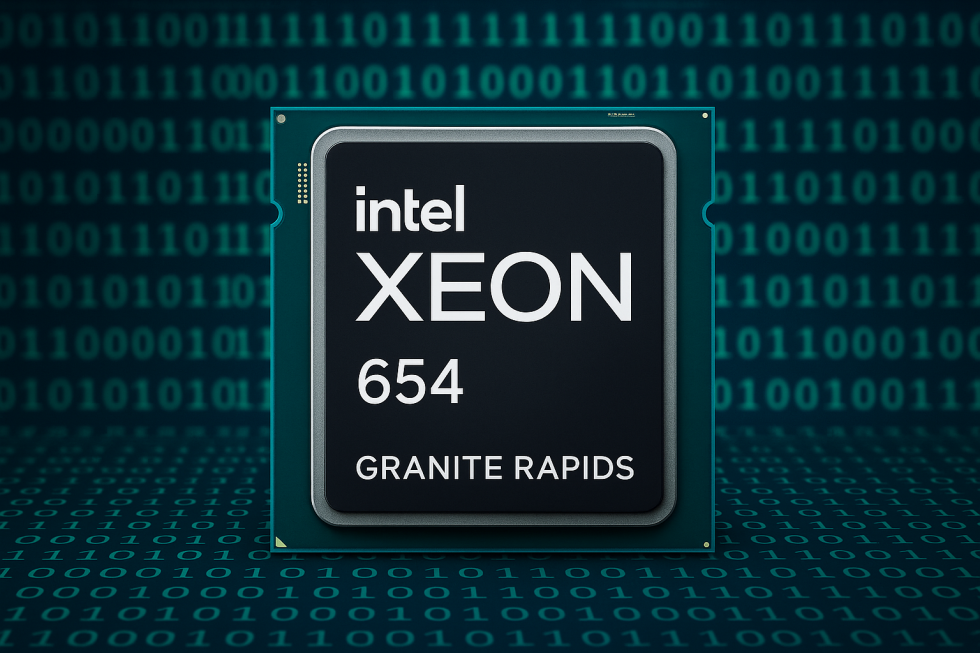
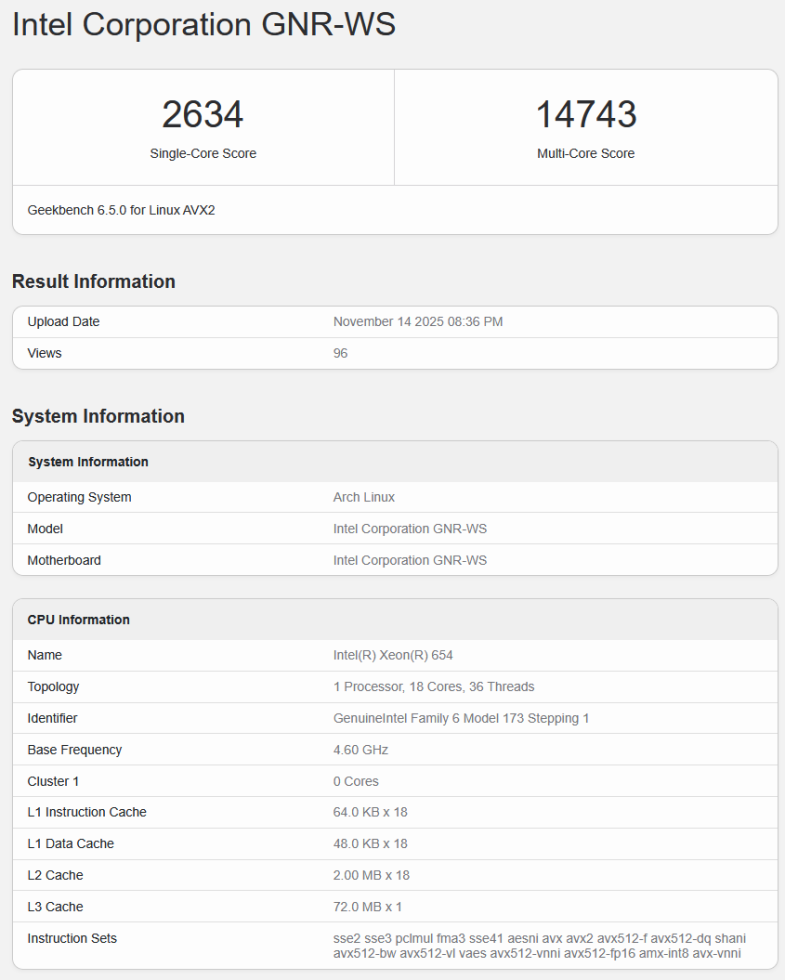
Intel is about to take the next big step in the workstation segment and, as is so often the case, it all starts with a leak. This time it concerns the new “Granite Rapids-WS” series, which is intended for professional users and workstations. At the heart of the latest unveiling is the Intel Xeon 654, an 18-core processor with 36 threads, which according to Geekbench entries clocks at up to 4.80 GHz and has a 72 MB L3 cache. Whilst AMD has recently taken the lead with the Threadripper 9000 chips, Intel is now preparing for the counter-maneuver, at least on paper.
The Xeon 654 was tested on a reference platform with 32 GB DDR5 RAM under Arch Linux. In Geekbench 6.5.0, the chip achieved 2634 points in the single-core test and 14,743 points in the multi-core test. This is solid, but by no means spectacular, especially not in comparison to AMD’s Threadripper 7960X with 24 cores, which is clearly ahead in similar benchmarks. However, the Xeon 654 is still a so-called “Engineering Sample” (ES), i.e. a pre-production model with immature firmware and non-final clock behavior. The real performance impression could still change significantly with the series version.
Technically, the Xeon 654 is based on the Granite Rapids platform, which is intended to offer two classes of CPUs: a mainstream version with four DDR5 channels and 80 PCIe 5.0 lanes and an expert version with eight memory channels and up to 128 PCIe lanes. The platform is clearly aimed at professional users, from CAD developers and simulation experts to high-end content creators. Granite Rapids is therefore the direct successor to Sapphire Rapids, but with a significantly revised structure, more efficiency and, above all, more upward scaling.
What is particularly interesting is the large number of planned SKUs, which have now also been leaked in advance. At the top is a Xeon 698X with an incredible 86 cores and 336 MB cache, an absolute monster that positions itself in direct competition with AMD’s Threadripper Pro 7995WX with 96 cores. Models with 72, 144 and 192 MB cache are also planned, with base clocks of 2.0 to 3.5 GHz. All chips with an “X” have the potential for overclocking, which is rather unusual in the workstation class, but is a clear pointer to enthusiasts and high-end users.
GNR-WS 🤔
678X : 2.40GHz 192M
676X : 2.80GHz 144M
674X : 3.00GHz 144M
658X : 3.00GHz 144M
656 : 2.90GHz 72M
654 : 3.10GHz 72M
638 : 3.20GHz 72M
636 : 3.50GHz 48M
634 : 2.70GHz 48M— 188号 (@momomo_us) November 15, 2025
The Xeon 654 is listed with a base clock of 3.10 GHz and a maximum boost of up to 4.80 GHz, which is quite impressive for an Intel workstation CPU. With 18 physical cores, it offers a solid balance between single-core performance and parallel computing power, ideal for applications such as rendering, software compilation or scientific simulations that benefit from many threads but also require high IPC values.
Intel is still silent on power consumption, but if you look at the other Granite Rapids leaks, such as the top model with a TDP of up to 350 watts, the Xeon 654 is unlikely to be a power saver either. The question of efficiency versus performance will therefore once again play a central role, especially when it comes to scoring points in the professional segment against AMD, which is currently doing very well with the Threadripper 9000 chips, not only in terms of cores, but also in terms of energy management.
Intel has yet to reveal anything about the price. Although details on the market launch are unclear, a launch towards the end of Q4 2025 or at CES 2026 is considered likely. One thing is certain: If Intel wants to be competitive with Granite Rapids, it needs to score points not only in terms of performance and platform, but also with an aggressive pricing strategy. AMD has shown how to win over workstation users with clear product lines, open platforms and a high number of cores.
Conclusion: The Intel Xeon 654 marks the entry into the new Granite Rapids generation for workstations, with a high clock rate, lots of cache and classic Xeon character. It is still too early to make final judgments, but the leak shows that Intel is getting serious. Only final benchmarks and prices will show whether this is enough to compete with AMD in the workstation market. In any case, the direction is right: less compromise, more scaling and hopefully fewer delays than with Sapphire Rapids.
Source: WccfTech























2 Antworten
Kommentar
Lade neue Kommentare
Urgestein
Urgestein
Alle Kommentare lesen unter igor´sLAB Community →