














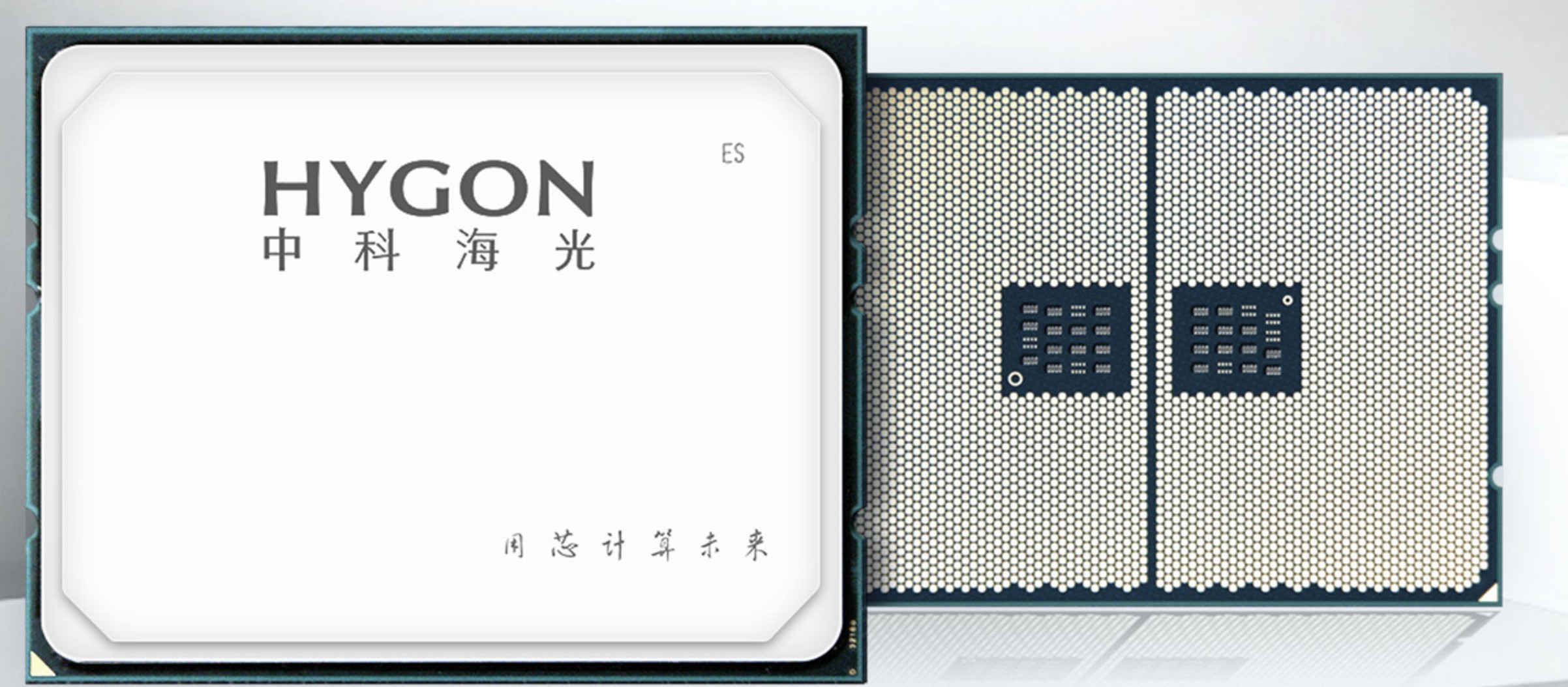
China has been working for many years to develop its own semiconductors based on its own technologies or licensed foundations in order to reduce its dependence on Western manufacturers. These projects include Hygon, a company based on a licensed version of AMD’s Zen architecture. The Hygon C86-4G 3490 represents one of the most visible steps towards independent x86 processors to date. The key technical data is reminiscent of earlier high-end models such as the Ryzen Threadripper 1950X, as it uses a 16-core configuration with 32 threads and a 32 MiB L3 cache. At the same time, it is noticeable that Hygon integrates modern interfaces such as DDR5 and PCI-Express 5.0, which suggests an updated platform and adjustments compared to the original Zen base. However, information on the exact production, boost-relevant clock rates or other microarchitectural details is still not available, meaning that many technical aspects can only be assessed on the basis of the reported performance data.
Introduction and background
The Hygon C86-4G (OPN 3490) is an x86 processor that is being promoted in China as a “domestic” alternative to Western CPUs. It has 16 cores and 32 threads, 32 MiB L3 cache and a reported base clock speed of 2.8 GHz. The chip supports modern system features such as DDR5 and PCIe 5.0. AMD’s licensing of the microarchitecture is apparently behind the project: according to reports, the chip uses a Zen-based architecture – at least in parts – although Chinese media suggest that the C86-4G is “newly developed”. The C86-4G is currently being used in complete systems (“gaming PCs”), for example according to the manufacturer Thunderobot. This is said to be the first time that a domestically produced x86 PC has been realized for the mass market.
The C86-4G is remarkable from two perspectives: firstly, as a political/economic statement, as it symbolizes China’s ambition to establish a local alternative in the x86 CPU sector. Secondly, as a technically interesting hybrid product: a Zen-based processor with modern I/O infrastructure (DDR5, PCIe 5.0). However, considerable doubts remain: the low single-core performance and the relatively low base clock (2.8 GHz) indicate that this is not a completely new high-performance design, but rather a new edition based on Zen with updates to I/O and system connectivity. In addition, many details are unclear: information on the manufacturing process, boost clock, energy consumption, power supply, thermal efficiency or stability is scarce or contradictory (in one screenshot, a TDP of over 55,000 watts is said to have been displayed, which of course indicates an error in the readout.
Technical specifications & architectural considerations
According to public benchmarks and hardware databases, the C86-4G should have the following key values:
-
16 cores / 32 threads
-
32 MiB L3 cache
-
Base clock 2.8 GHz
-
Support for DDR5, PCIe 5.0
However, there are initial indications that the I/O die (memory controller, PCIe) has been adapted to enable modern standards such as DDR5 and PCIe 5.0. Since AMD’s original Zen generation did not natively support DDR5 or PCIe 5.0, this indicates that Hygon has at least revised parts of the chip design. It is not possible to verify from the outside whether this is a completely proprietary I/O die or merely a technical “tuning” within licensed Zen chips.
Multi-threading / rendering / CPU-intensive workloads
According to current reports, the C86-4G shows respectable results in multi-core workloads. In some integer and floating point benchmarks, it achieves values comparable to those of the Intel Core i7-13700 or even the Intel Core i7-14700. It therefore exceeds the i7-13700 in integer multi-core tests and is also close in floating point tests. In rendering workloads (benchmark with V-Ray), the manufacturer reports higher throughput than the i7-13700 and a considerable lead over older CPUs such as the i7-12700. However, the gap to the i7-14700K remains at around 22 percent.
Single-core performance and everyday use / games
The C86-4G clearly falls behind in single-thread benchmarks. Example: according to Geekbench data (quoted in reports), single-core scores of around 1,073 points are recorded, with all cores (maximum) around 8,811 points. For comparison: Modern Zen 3/Zen 4 or Intel processors generally achieve significantly higher single-core scores. This means that the C86-4G lags far behind current top models in terms of single-core performance. This is likely to be particularly noticeable in applications or games that rely heavily on single-thread performance. According to the published specifications, the processor can still run Windows-based software and games such as Valorant or Black Myth: Wukong. However, it remains unclear how representative this information is, as specific benchmarks for games are rarely or never documented.
PassMark / PerformanceTest – practical everyday assessment
According to the PassMark database, the C86-4G achieves an “Overall CPU Mark” of around 21,968, a multi-thread score of 21,968 and a single-thread score of 1,745 (as of November 2025). Compared to top processors, this is significantly lower. This indicates that the chip cannot compete with high-end CPUs in terms of efficiency, price-performance or energy balance, at least at present.
First gaming PC emerges
The manufacturer Thunderobot is now installing this processor for the first time in a gaming system called the Black Knight Hunter Blade Pro, which is aimed specifically at gamers. Full x86 compatibility is to be guaranteed, which means that common applications and games can still be run. Despite this compatibility, however, there are clear limitations in terms of performance. The base clock of 2.8 GHz is set low and the reported benchmark values indicate that the processor has difficulties utilizing its high core count efficiently.
The results are significantly lower than those of modern processors, as current top models such as the Ryzen 9 9950X3D achieve more than three times the performance in the single-core range. Measurements from V-Ray or SPEC CPU 2006 also paint a similar picture. The C86-4G 3490 is said to achieve approximately the performance level of an Intel Core i7-14700 with all cores, whereby it can be assumed that the energy requirement is higher and the efficiency does not come close to modern production processes.
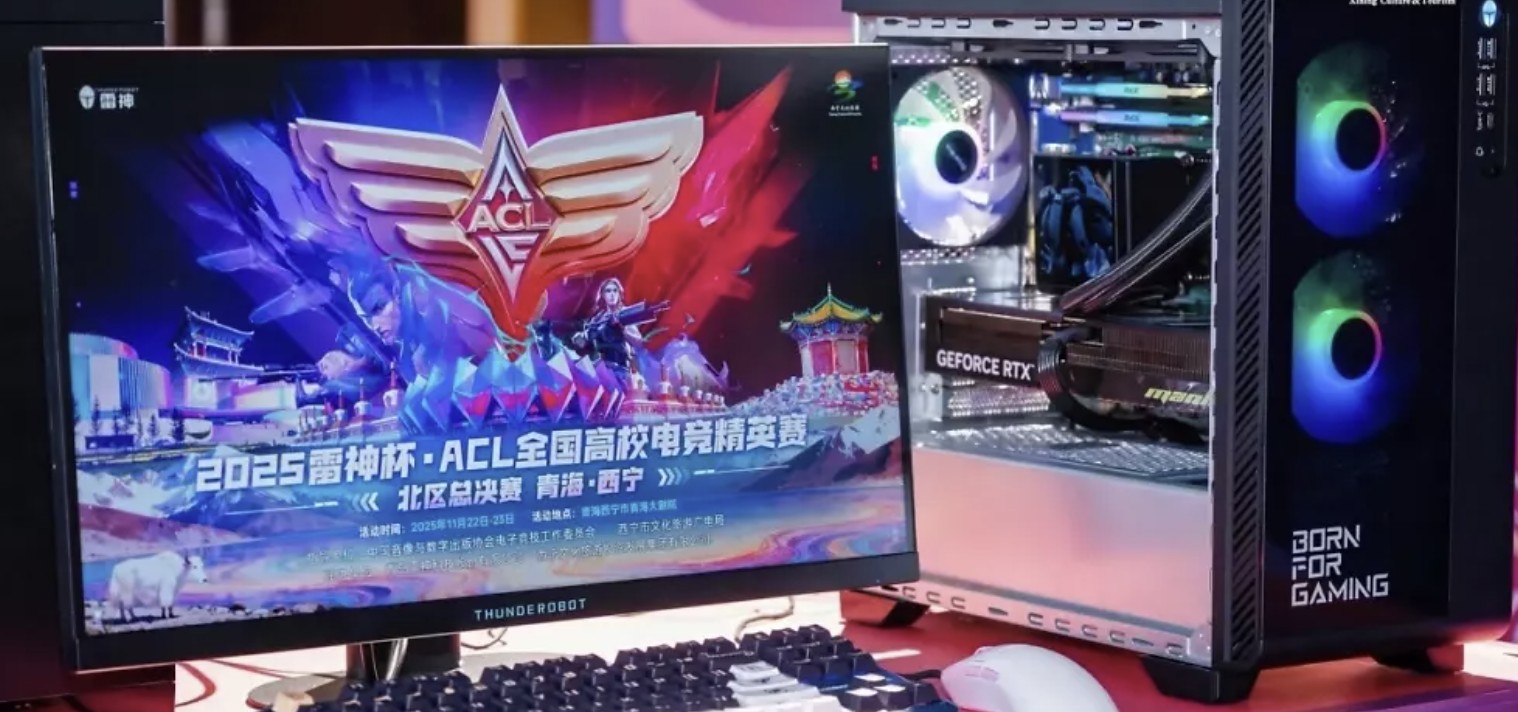
Despite these limitations, the processor should offer sufficient performance in everyday use and under light to medium gaming loads. However, Thunderobot does not rely on a Chinese graphics unit in its gaming model, but on a GPU from Nvidia. This clearly shows that China is still several years behind Western products when it comes to the development of graphics chips. Although various manufacturers already have their own GPU approaches, the solutions currently available do not come close to conventional gaming graphics cards in terms of efficiency or gaming performance. The use of an Nvidia GPU is therefore the obvious choice for systems that need to remain suitable for gaming. This results in a PC that uses a CPU developed in China but is still dependent on Western graphics technology. The combination shows both the progress of Chinese semiconductor initiatives and their current limitations.
Conclusion and conclusion
The Hygon C86-4G is an interesting product with symbolic value for the Chinese semiconductor industry. For workloads that benefit greatly from multi-threading (rendering, server-like applications), the processor can certainly advance into the regions of current Intel CPUs. For desktop use, games or applications with a high single-thread load, however, the C86-4G appears to be at a clear disadvantage compared to current AMD or Intel CPUs. As far as can be judged, the architecture appears to be a compromise: modern I/O features based on older CPU cores. From the point of view of a tech-savvy observer, the C86-4G would only be of interest if China-incompatible import restrictions were to take effect, because for the normal global market, the added value compared to established alternatives remains limited. The Hygon C86-4G 3490 marks an important step in the attempt to make own x86 processors ready for the market, but the distance to the current high-end class remains clearly visible.
| Source | Content / Key message |
|---|---|
| Blog post on zhihu.com: “中国海光16核芯片挑战AMD线程撕裂者!” | The article mentions Hygon C86-4G 16 cores / 32 threads as a direct competitor to AMD Ryzen Threadripper 1950X, with single-core Geekbench score approx. 1073, multi-core score approx. 8811. > “其单核跑分比较低,仅为1073分,与老旧的Haswell和Skylake处理器相当” Zhihu |
| Article on hkepc.com: “Hygon C86-4G 處理器首次曝光 16 核、32 線程 效能媲美 Raptor Lake” | Reports the 16-core/32-thread configuration with 32 MiB L3 cache, support for DDR5 and PCIe 5.0 for the first time. Mentions comparability with Raptor Lake Core i7 CPUs. HKEPC Hardware |
| Blog post on csdn.net (weixin blog): “中国海光16核芯片挑战AMD线程撕裂者!” | Indicates that C86-4G (also called C86 3490) has 16 cores / 32 threads, base clock 2.8 GHz, and was tested under a Linux system (openKylin 2.0) with 32 GiB RAM. Multi-thread performance close to the older Threadripper, single-core significantly weaker. CSDN Blog |
| Article “海光新款16核处理器曝光:多核性能相比上代8核提升60%” (Chinese) | Mentions specific Geekbench result: single-core 1073, multi-core 8811. Refers to the previous 8-core variant and speaks of an approximately 60% better multi-core performance – which is rather moderate given the doubled number of cores. i凤凰网 |
The sources were translated with DeepL










9 Antworten
Kommentar
Lade neue Kommentare
Mitglied
Veteran
Urgestein
Mitglied
Veteran
Mitglied
Urgestein
Veteran
Veteran
Alle Kommentare lesen unter igor´sLAB Community →