














With the Core Ultra 5 335 and Core Ultra 5 325, two more representatives of Intel’s upcoming Panther Lake family have appeared in the Geekbench database. These are early sightings, no launch measurements, no validated performance statements. Anyone expecting headlines about leaps in performance now should shift down a gear.
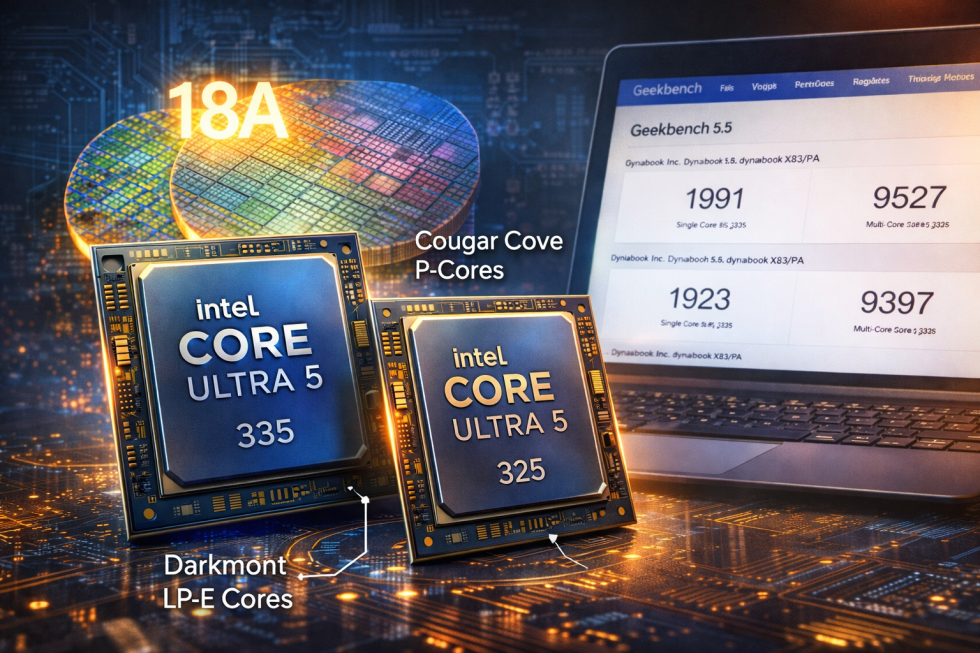
Panther Lake clearly positions Intel above Lunar Lake. Instead of 17 to 37 watts like its extremely efficiency-driven predecessor, Panther Lake targets a wider window of around 25 to 55 watts. Intel is thus targeting classic notebooks, mobile workstations and performance-oriented ultrabooks, i.e. precisely the class in which AMD has recently had an unpleasant presence. The two models on display are based on an 8-core design without SMT, consisting of 4 performance cores and 4 LP-E cores. Classic efficient cores are completely absent. This is not an oversight, but a deliberate design decision. These chips are in fact the direct successors to the Core Ultra 200V series and aim for constant, predictable performance instead of maximum thread scaling.
The test was carried out on Geekbench version 5.5, which significantly limits the significance. Geekbench 5 scales differently, uses older compiler paths and only maps modern hybrid architectures to a limited extent. Accordingly, the results are around 2,000 points in single-core and just over 9,000 points in multi-core. These figures seem unspectacular on paper, but are worthless when viewed in isolation. The confirmed key data is more interesting. The Core Ultra 5 325 boosts up to 4.5 GHz, the 335 reaches 4.6 GHz. Both have 12 MB L3 cache, a noticeable plus compared to the previous 200V models. This indicates that Intel has deliberately optimized the memory hierarchy for real workloads and not for marketing benchmarks.
Architecturally, the performance cores are based on Cougar Cove, while the LP-E cores come from the Darkmont family. Intel itself claims that Darkmont should be faster than previous Raptor Cove P cores in certain scenarios. This is an ambitious claim that has yet to be proven. In any case, this claim should not be based on Geekbench 5 leaks. Panther Lake is manufactured on Intel’s internal Intel 18A process, which strategically goes far beyond these CPUs. Panther Lake is less a product launch than a vote of confidence. If 18A doesn’t deliver here, it will also be awkward for later desktop and server offshoots. The Core Ultra 7 365, which has also been spotted so far, was not convincing in early tests. Whether this was due to immature BIOS versions, conservative power limits or simply the test environment remains to be seen. This is precisely why the latest Ultra 5 leaks should be treated with caution. Without Geekbench 6 values, without real comparison platforms and without knowledge of the TDP configuration, everything remains provisional.
The bottom line is that the entries show one thing above all. Panther Lake will not be a radical break, but a controlled shift in the balance between efficiency, clock speed and cache. This is necessary for Intel, but only relevant for buyers when valid benchmarks and real devices are on the table. Until then. Interesting, but not yet reliable.
| Source | Key statement | Link |
|---|---|---|
| Geekbench Browser | The Intel Core Ultra 5 335 was tested in a Dynabook X83/PA with 8 cores, 12 MB L3 cache and up to 4.6 GHz boost clock in Geekbench 5.5. | https://browser.geekbench.com/v5/cpu/ |
| Geekbench Browser | The Intel Core Ultra 5 325 achieves similar single and multi-core values as the Core Ultra 5 335 and confirms the 4P 4LP-E core configuration without SMT. | https://browser.geekbench.com/v5/cpu/ |
| Intel | Panther Lake is based on the Intel 18A manufacturing process and combines Cougar Cove-P cores with Darkmont LP-E cores for mobile platforms. | https://www.intel.com/content/www/us/en/newsroom/news/intel-panther-lake-architecture.html |
| Intel | The Core Ultra 5 Panther Lake models have an extended L3 cache compared to the previous Core Ultra 200V series. | https://www.intel.com/content/www/us/en/products/details/processors/core-ultra.html |






















1 Antwort
Kommentar
Lade neue Kommentare
Veteran
Alle Kommentare lesen unter igor´sLAB Community →