














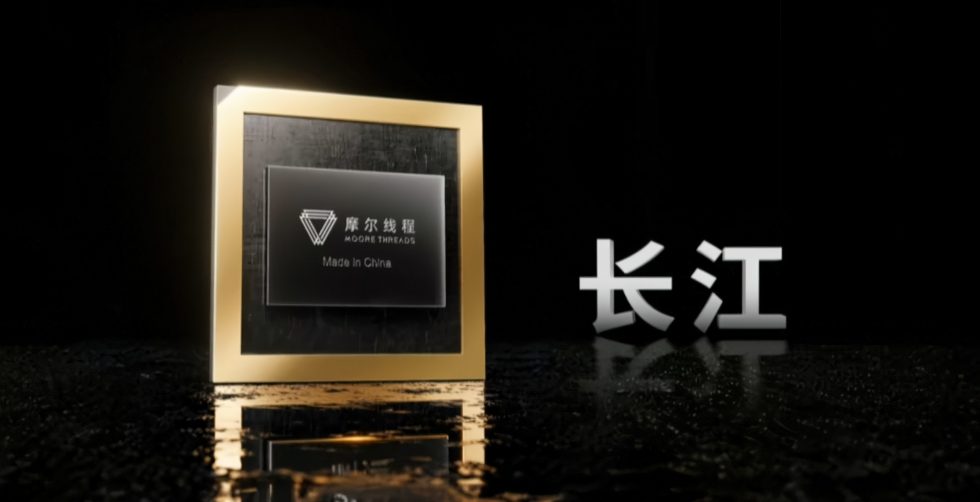
With the introduction of the Yangtze SoC, Moore Threads is making it clear that it no longer wants to limit itself to discrete GPUs or pure accelerator roles, but is claiming to deliver a fully integrated platform for so-called AI PCs. The move is strategically noteworthy, as it comes at a time when the PC market is being reorganized and AI acceleration is moving from an additional feature to a basic expectation. Yangtze should therefore be seen less as an isolated product and more as an attempt to build an independent Chinese SoC alternative to the Western-dominated platforms.
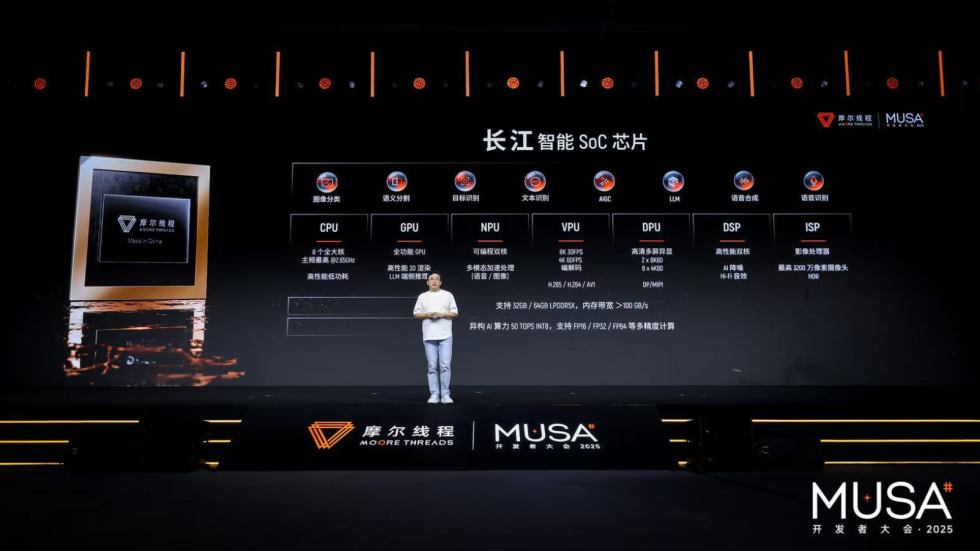
Architecturally, Moore Threads remains remarkably vague, which is probably no coincidence. An eight-core CPU cluster with a maximum clock speed of 2.65 GHz has been confirmed, which seems unspectacular in a classic desktop comparison, but takes on a different significance in the context of a power-saving, highly integrated SoC. The CPU is not the sole performance anchor here, but part of a heterogeneous overall system in which specialized units take on a large part of the workload. This is precisely the core of the Yangtze strategy: computing power is no longer scaled primarily via high frequencies, but via functional diversification. The central component is the integrated NPU with a specified performance of up to 50 TOPS in INT8 format. This figure is clearly tailored to typical AI PC workloads, i.e. speech recognition, image processing, local inference of small to medium-sized models and assistance functions, not to the training of large models. Moore Threads has deliberately positioned Yangtze below classic data center accelerators, but well above the performance of previous mobile CPUs with integrated AI units. The NPU has a multi-core design, which is aimed at parallel processing and energy efficiency, two factors that are crucial in the notebook and mini PC segment.
The SoC is supplemented by an integrated GPU, the exact origin of which remains open, but which, according to the manufacturer, can handle both classic 3D graphics as well as AI acceleration and modern video workloads. Modern codecs such as H.264, H.265 and AV1 are supported, including 8K decoding and 4K encoding at high frame rates. Yangtze therefore not only addresses office or AI assistance scenarios, but also media production, streaming and content consumption, i.e. precisely those mixed loads that modern mobile systems have to cover. In addition, there are several specialized subsystems that underline the claim of a true all-in-one SoC. An integrated DPU enables the operation of several high-resolution displays simultaneously, up to dual 8K setups or a multitude of 4K outputs, which is relevant for mini-PC and embedded scenarios. A dedicated DSP takes care of audio processing, including AI-based noise reduction and hi-fi effects, while an ISP handles cameras up to 32 megapixels with HDR support. These function blocks are not a minor matter, but reduce external components, lower latencies and improve the energy efficiency of the overall system.
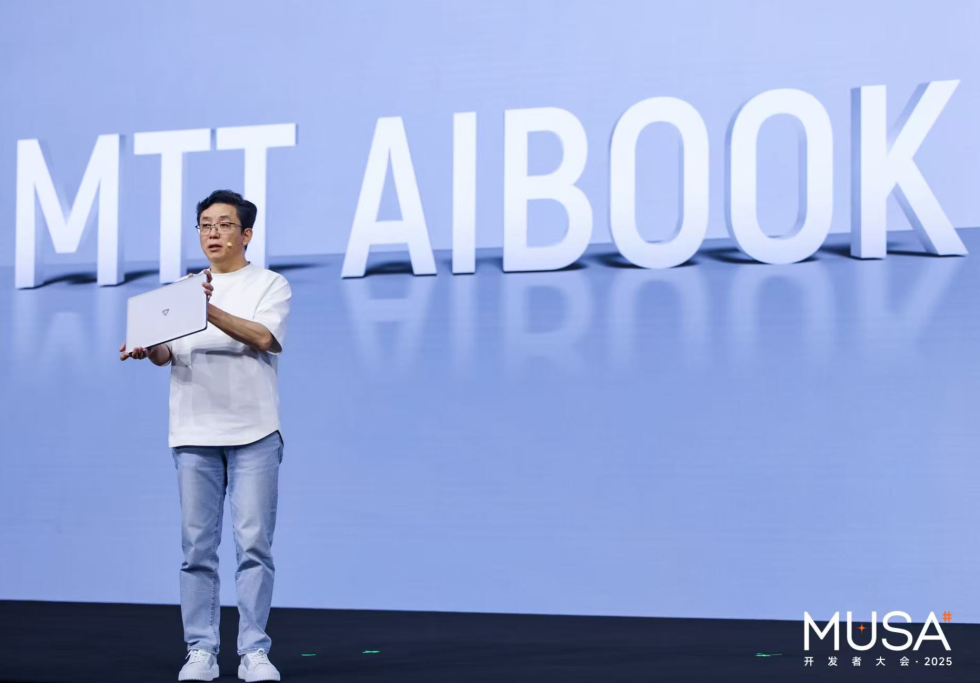
At platform level, Moore Threads is already showing concrete implementations, including a notebook design and a compact mini PC, both of which are clearly aimed at the domestic market. LPDDR5X memory configurations with 32 or 64 GB capacity and a bandwidth beyond 100 GB/s are supported, which is crucial for AI inference, integrated graphics and multitasking. The fact that the SoC supports FP16, FP32 and FP64 formats indicates that the focus is not only on simple consumer workloads, but also on more technically demanding applications. Strategically, Yangtze is particularly relevant in a geopolitical context. China has been working for years to reduce technological dependencies in the semiconductor sector, and AI-enabled PCs are increasingly seen as a sensitive future segment. While Western suppliers such as Intel, AMD, Qualcomm, Apple and NVIDIA are aggressively pushing their own SoC roadmaps, Moore Threads is trying to establish an independent, locally available alternative with Yangtze. The goal is not so much to be a leader in every discipline, but to provide a functionally complete, controllable ecosystem that is “good enough” to cover a wide range of application scenarios.
The bottom line is that Yangtze is not a product that will immediately shake up the global market, but a strategic marker. Moore Threads is demonstrating that it is capable of integrating complex SoCs with CPU, GPU, NPU and media blocks and deriving marketable systems from them. Whether this platform is competitive in the long term depends less on the bare TOPS or GHz values than on the software ecosystem, driver maturity and the ability to scale production stably. Nevertheless, Yangtze is a clear signal for the Chinese market: the ambition goes beyond imitation, towards its own platform sovereignty in the AI PC era.
| Source | Key message | Link |
|---|---|---|
| Moore Threads MUSA Developer Conference 2025 | Moore Threads introduces the Yangtze AI SoC as a fully integrated CPU, GPU and NPU platform for AI PCs. | https://mthreads.com/en/news/musa-developer-conference-2025 |
| Wccftech – Moore Threads Launches Yangtze AI SoC | The Yangtze SoC offers eight CPU cores, up to 2.65 GHz clock speed, an integrated GPU and an NPU with up to 50 TOPS for AI PC applications. | https://wccftech.com/moore-threads-launches-yangtze-ai-soc-8-cores-50-tops-npu |
| Moore Threads Product Brief Yangtze | The SoC supports LPDDR5X memory up to 64 GB, modern video formats including AV1 and multi-display output up to 8K. | https://mthreads.com/en/products/yangtze-soc |
| China Semiconductor Industry Association | Chinese semiconductor companies are pushing independent SoC and AI platforms to reduce technological dependencies. | https://www.csia.net.cn/Article/ShowInfo.aspx?InfoID=25892 |











Bisher keine Kommentare
Kommentar
Lade neue Kommentare
Artikel-Butler
Alle Kommentare lesen unter igor´sLAB Community →