















Over the past few months, I have received many inquiries regarding the availability and authenticity of Honeywell PTM7950 pads. The Linus Tech Tips store, which has become one of the few reliable publicly accessible sources for this material, was mentioned particularly frequently. The pads offered there are considered trustworthy in the scene because the distributor has been consistently relying on original goods for a long time and this is also communicated accordingly in the LTT store environment. Many readers have therefore contacted me and asked if I could test these pads myself to get an independent assessment. That is exactly what I would like to do today.
I will focus on the burn-in behavior, the resulting performance and the layer thickness after burn-in. For comparison, I will use an original PTM7950 from an OEM source with a thickness of 0.2 millimeters (printed 0.25 mm) and a Laird TPCM 7000, which is also 0.2 millimeters thick, but appears slightly less soft in its initial state. The burn-in curves of the original Honeywell pads are very characteristic and generally allow a reliable assessment of authenticity, because deviations in the material or in the formulation have immediately visible effects on the thermal transient response. The measurements presented today should therefore not only provide a comparison, but also serve as an indicator of whether the pads examined actually correspond to the known Honeywell characteristics.
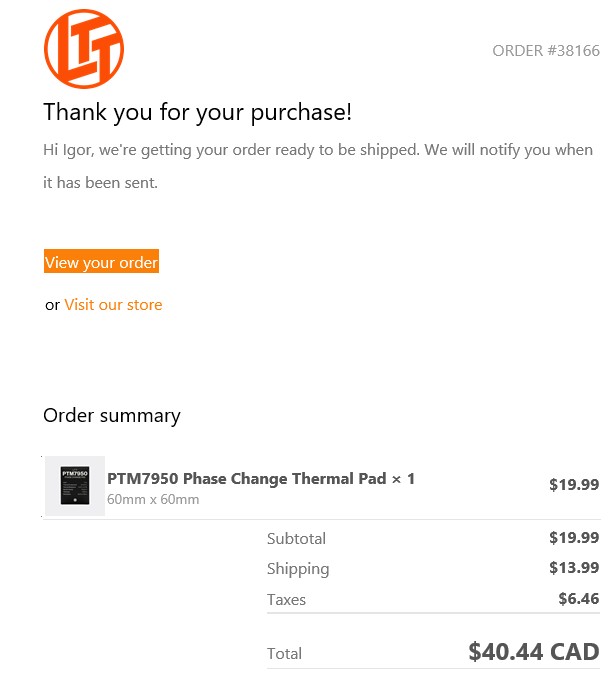
Naturally, I ordered the pad in question anonymously and without any special labeling from the LTT store, just as any normal customer would do. This ensures that the material supplied does not receive any special treatment and that the subsequent measurements are carried out under the same conditions as for any other buyer. Yes, it took a while, but the parcel arrived here neatly packaged and undamaged.
What you get: Packaging and scope of delivery
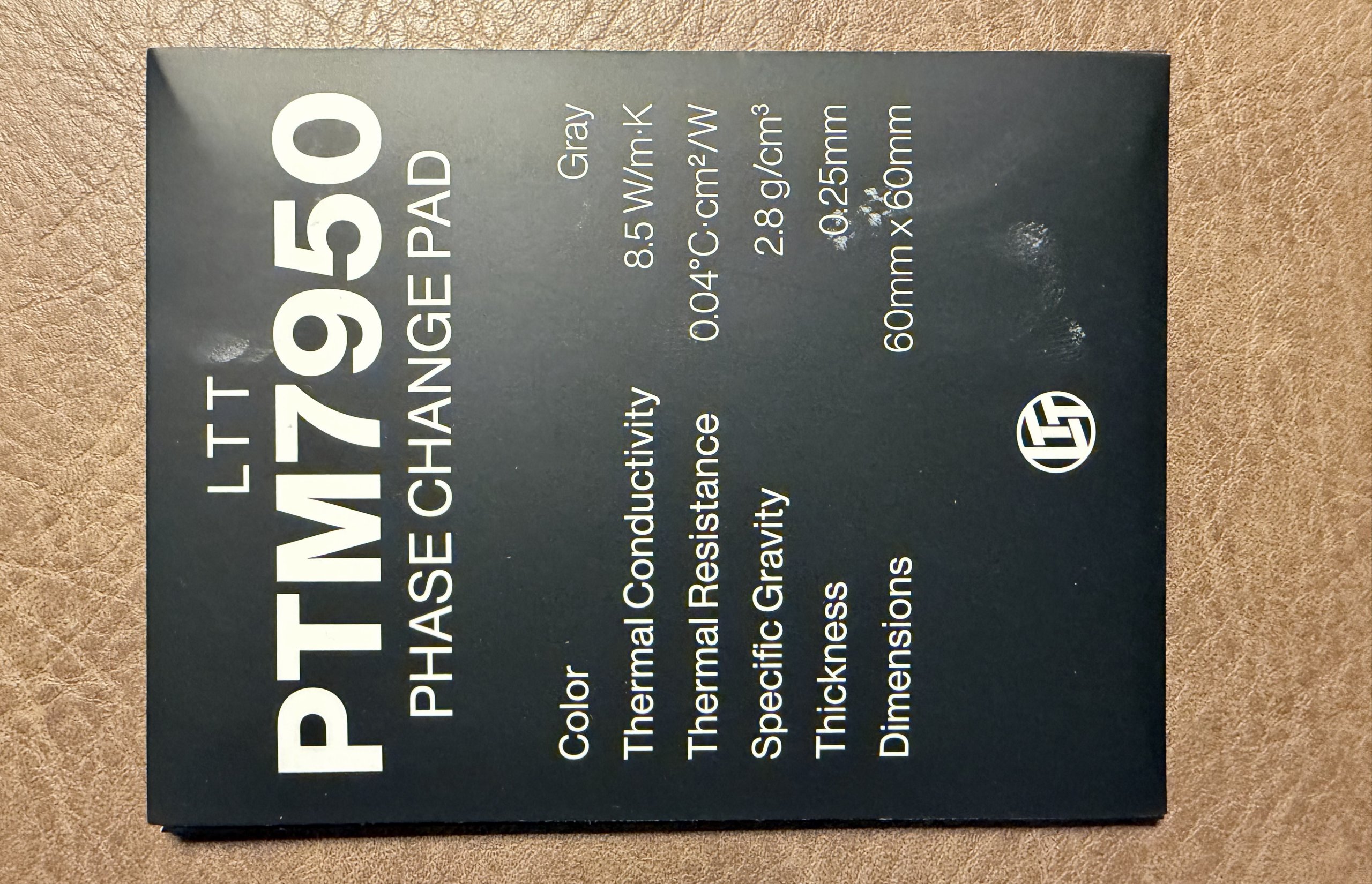
The delivery consists of a black cardboard box and an orange inner box containing the actual pad. The outer packaging is kept very simple and relies exclusively on the LTT branding, with no mention of Honeywell or PTM7950 as the manufacturer visible anywhere. The front is dominated by the large imprint “LTT PTM7950 Phase Change Pad” and the technical specifications, which are printed in contrasting white lettering on the matt black cardboard. Visually, this is more reminiscent of a classic retail accessory than a pure OEM industrial product, which fits in with the positioning in the LTT store.
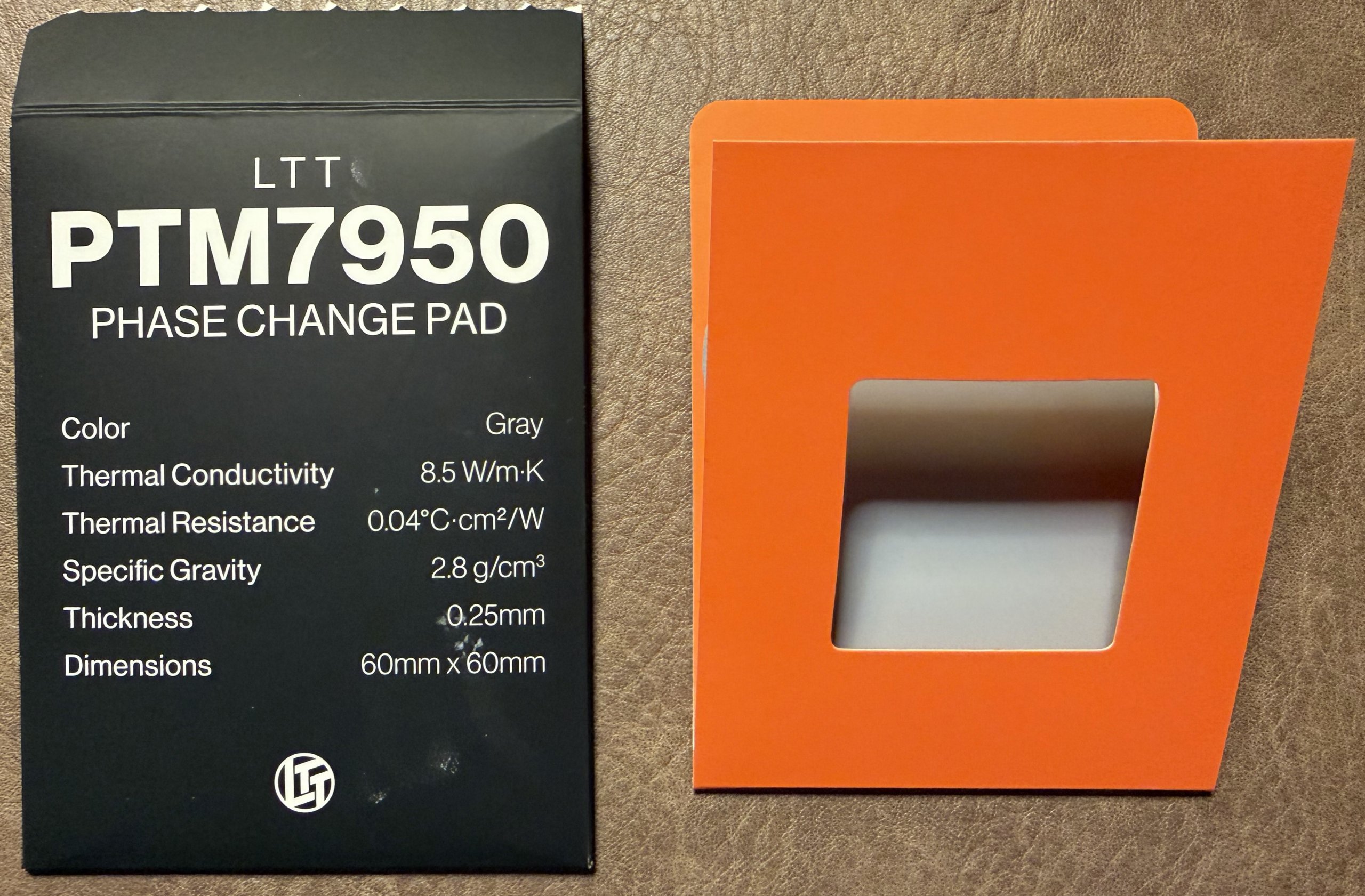
The technical specifications are printed in full on the front. The color “Gray”, a thermal conductivity of 8.5 W/m-K, a thermal resistance of 0.04 °C-cm²/W, a specific density of 2.8 g/cm³, the nominal thickness of 0.25 mm and the dimensions of 60 mm × 60 mm are specified. This means that all the key data required for an initial classification, for example in comparison to other phase change materials or classic thermal pads, can be found directly on the packaging. It is striking that the thickness is also clearly specified as 0.25 millimetres, whereas the well-known Honeywell PTM7950 is specified as 0.25 millimetres in practice (and in the data sheet) and many imitators use 0.2 mm. I will of course check and compare this, as I also have a Honeywell pad with a measured 0.2 mm in my archive (within the tolerance limits).
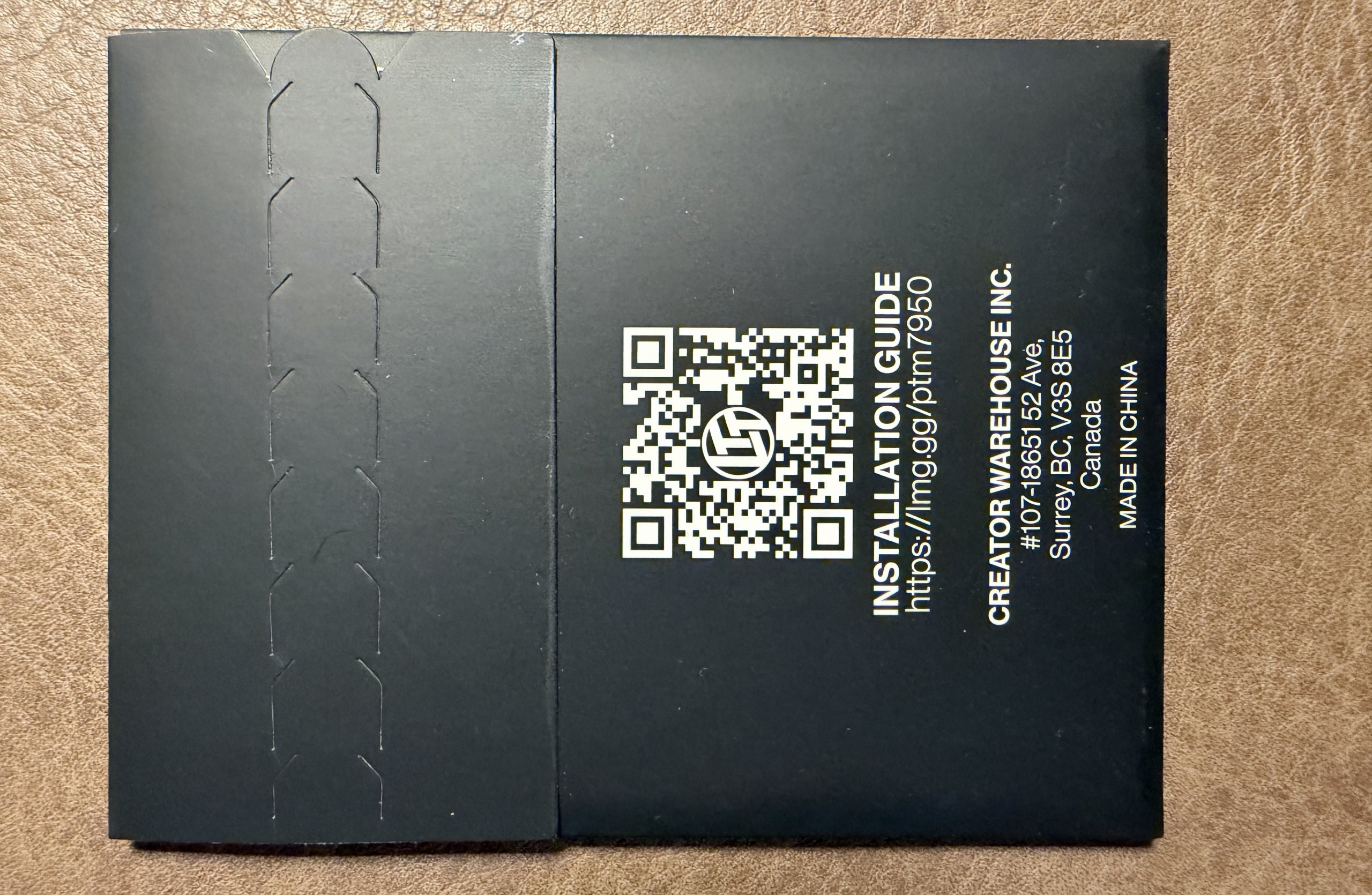
The workmanship of the box looks solid, but functional and without any special effort. It is a tear-open flap that is easy to open and can then be pushed back in. The LTT logo can be found discreetly at the bottom edge, otherwise the design is deliberately understated. This makes sense for a consumable product such as a phase change pad, as you want to see the costs in the product rather than in elaborate packaging.
Inside there is a second cardboard element in bright orange, which forms a kind of frame with a viewing window. The gray pad can be seen through this rectangular window even before it is unpacked. This intermediate packaging also serves as a carrier and protection, as the pad lies flat on a white carrier film and is protected against creases and unwanted contact with the environment by the frame. This is practical because the material can be safely removed from the outer packaging and only removed from the frame at the workplace without damaging it with your fingers.
The actual pad lies on a white carrier card and takes up almost the entire visible surface. It is a large, gray rectangle that looks more like a thin, evenly coated film in the orientation shown. The surface appears homogeneous and slightly matt, without any recognizable filler agglomerates or visible inclusions. In terms of color, it corresponds to the typical gray known from PTM7950, although it must be said that color nuances in photos can only be compared to a limited extent, so I cannot consider this a clear sign of authenticity at this point.
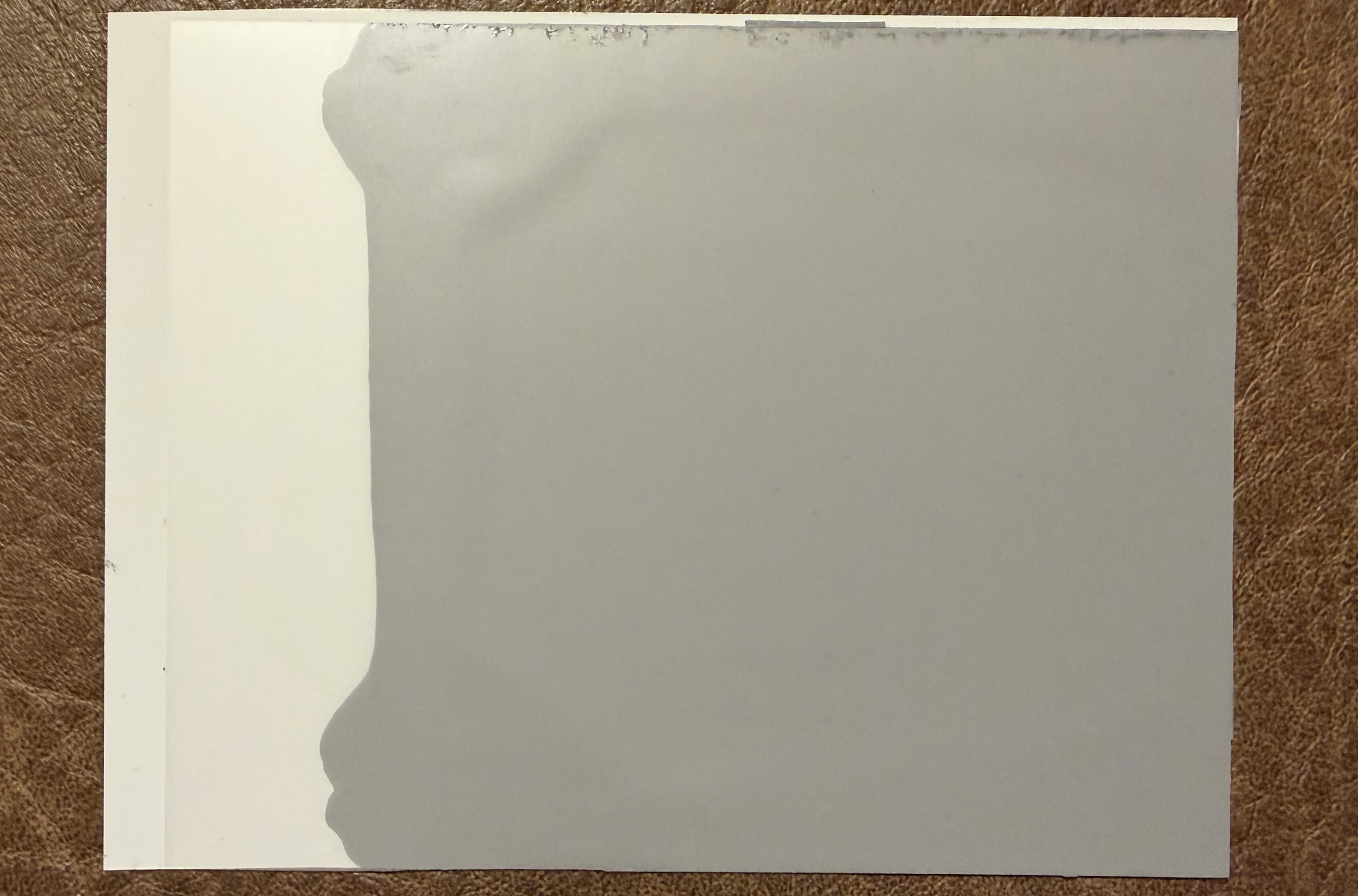
At the upper edge, you can see a narrow zone where the material runs out slightly irregularly, with minimal waves and a somewhat thinner-looking edge. This is not unusual for phase change materials applied over a large area and indicates that the pad was applied to the carrier film as a closed layer and the edge area had a very slightly different shape during coating. A kind of “indentation” can also be seen on the left, where the coating does not quite reach the edge, resulting in a characteristic curved edge. Such small edge artifacts are completely uncritical in normal use, but on closer inspection they can provide clues as to the nature of the coating process. For later use, a smaller section is cut out in the area of the evenly coated surface anyway, so that this edge zone does not end up on the contact surface.
The coating appears somewhat uneven overall; there are slight bubbles but no cracks or delamination. This suggests, at least visually, that the material was applied reasonably correctly and that storage up to the time of photography was not critical. How soft or tough the pad actually is when cold cannot, of course, be judged from the pictures; handling during sample preparation and, above all, the behavior during the burn-in cycle will have to show this later. But I can already spoil that it will be interesting.
All in all, the packaging and delivery give the impression of a neatly assembled retail product that is technically well labeled and whose pad arrives in visually perfect condition. Whether the printed values and the visual impression also match the real thermal behavior and how close the whole thing is to the known OEM PTM7950 must be clarified by the following measurements, everything else would be pure speculation at this point in time.




















22 Antworten
Kommentar
Lade neue Kommentare
Veteran
Veteran
1
Urgestein
Urgestein
Mitglied
Mitglied
Urgestein
Urgestein
Urgestein
1
Urgestein
Urgestein
Veteran
Mitglied
Veteran
Urgestein
Mitglied
Urgestein
Alle Kommentare lesen unter igor´sLAB Community →