















With FSR Redstone, AMD presents the most comprehensive further development of its upscaling and frame generation technologies to date. The update not only expands the FidelityFX Suite with machine-trained upscaling and reconstruction processes, but also introduces a complete set of ML-based rendering aids for the first time, which should be noticeable in almost all phases of image construction. The presentation clearly shows that AMD does not want this generation to be understood as an incremental improvement, but as an organic overall system that provides coordinated modules, each of which fulfills its own tasks and together should enable higher image quality and significantly increased performance.
Even the chronology of FSR development to date clearly shows the extent of the upheaval. FSR 1 provided spatial upscaling, FSR 2 added temporal data, FSR 3 introduced frame generation and FSR 3.1 primarily served to refine quality while standardizing the API at the same time. With the emergence of FSR 4, AMD finally began to use neural models for upscaling. All these development stages now form the foundation for FSR Redstone, which is described in the presentation as a mixture of upscaling, frame generation, ray regeneration and radiance caching. Together, these modules are intended to provide an AI-based rendering pipeline that can hardly be compared with classic enhancements.
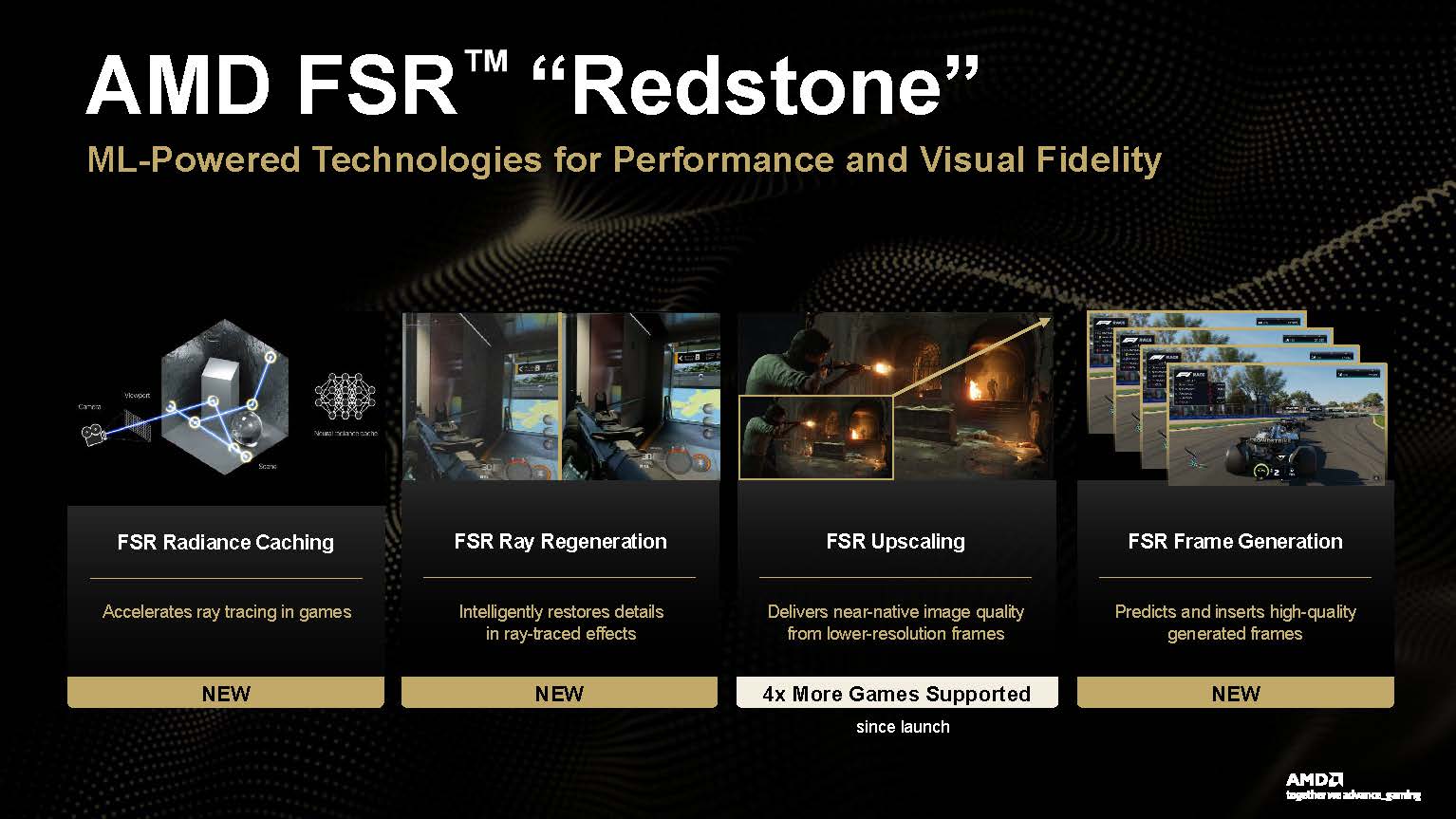
At the center of AMD’s technological updates is Radiance Caching, a machine-learned method for predicting indirect lighting. Traditional ray tracing determines light transport through full ray traversal and numerous surface interactions, which is accurate but extremely compute-intensive. The new approach relies on a neural model that infers indirect radiance after only a few sampling steps by drawing on previously learned correlations between geometry, material behavior, and lighting conditions. The goal is to accelerate global illumination without having to simulate every interaction explicitly. Practical use is currently limited to developers, while integration into commercial games is planned for 2026, indicating that AMD views this technology as a long-term strategic component that will likely play a key role in future Redstone iterations.
FSR Ray Regeneration introduces a fully ML-based denoiser designed specifically for ray tracing and path tracing workloads. While heuristic denoisers often struggle to incorporate broader contextual information, AMD’s neural model processes a wide set of inputs including depth and normal buffers, diffuse and specular components, radiance data, and optionally visibility information. As a result, image regions that would otherwise appear noisy or incomplete due to low ray counts can be reconstructed with greater stability and detail. A first practical deployment already exists in Call of Duty Black Ops 7, which uses this technique in its live rendering pipeline.
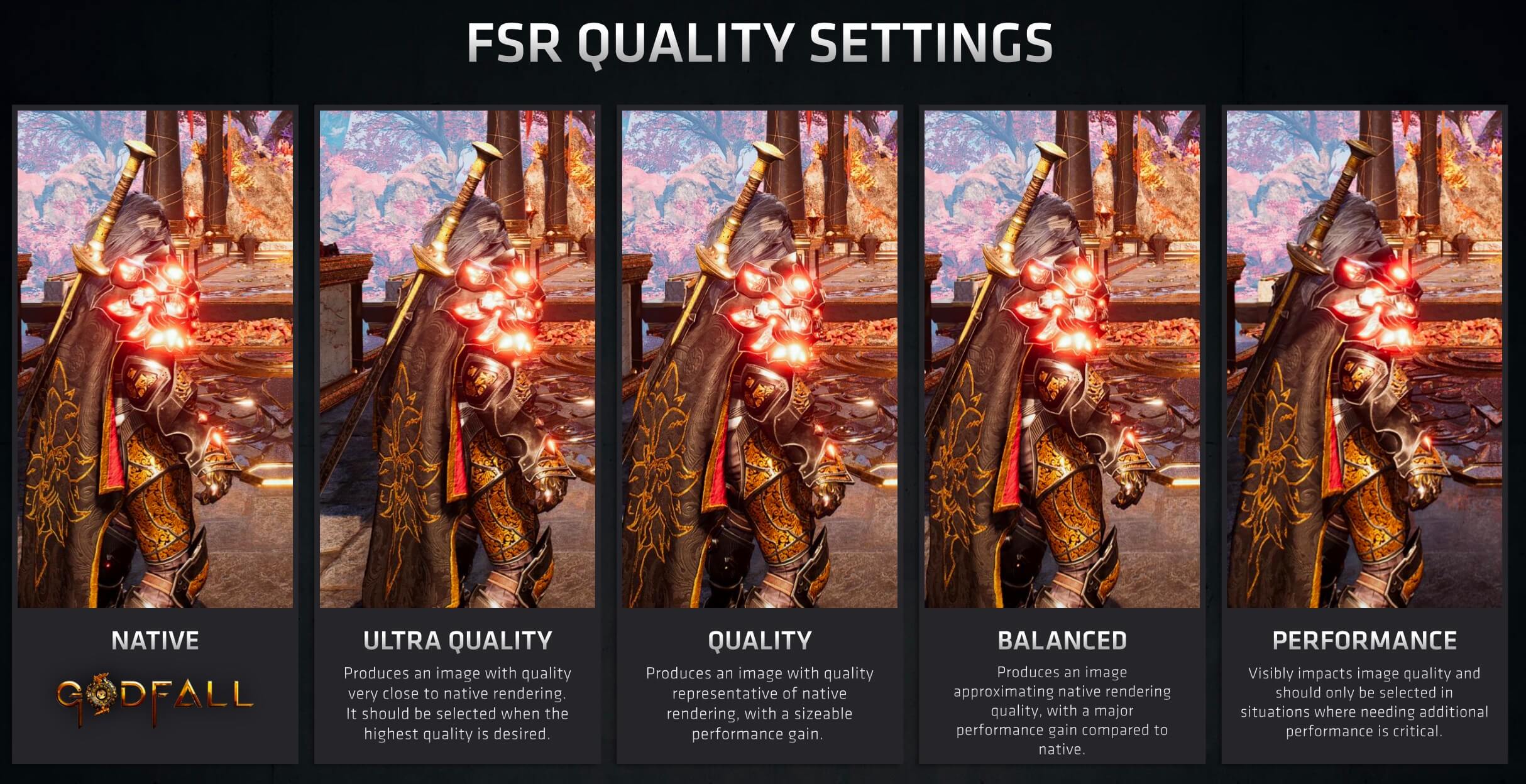
The most relevant component for everyday use, however, remains the upscaling stage, now implemented as an ML-based method under the Redstone umbrella. The upscaler reconstructs a high-resolution image from lower-resolution frames using motion vectors, depth data, color inputs, and a trained neural model. The objective is to approach native-resolution quality as closely as possible. The provided examples demonstrate that even in Performance mode, Redstone achieves a noticeably higher level of detail than earlier FSR versions.
This pipeline is further extended by the redesigned Frame Generation system, which now also relies on a neural model. By analyzing consecutive frames, along with motion vectors and ML-computed optical flow, the system synthesizes intermediate frames. The model was trained on challenging scenarios including rapid camera motion, complex lighting transitions, and problematic shadowed regions. The intent is to improve temporal stability and reduce common artifacts such as ghosting or motion smearing. When combined with ML upscaling, the result is a substantial increase in frame rate. Official examples using the Radeon RX 9070 XT show that, with ray tracing enabled, Call of Duty Black Ops 7 achieves a 4.7× performance gain compared to native 4K rendering.
Important preliminary remark
Of course, I also ran benchmarks today and even checked NVIDIA’s slide results, but my focus for the release of FSR Redstone is deliberately on the theoretical classification and the technical comparison with NVIDIA. This aspect seems particularly relevant to me on release day, as I know that many other sites will focus primarily on graphical comparisons and gameplay screenshots or videos. I therefore see my work more as a supplement to the usual image comparisons. Although I currently only have one game available for practical measurements, I have a large amount of detailed technical metrics at my disposal that allow me to draw conclusions about the architecture, model characteristics and internal functioning of AMD’s new ML Upscaling and ML Frame Generation.
This intentionally creates a different perspective that is less oriented towards subjective image perception and instead answers the question of how Redstone works internally, how it compares directly to NVIDIA in terms of technology and what potential or limits the architecture reveals from today’s perspective. I think this analytical perspective is particularly valuable at the start, as it creates a sound basis for later, broader practical tests and readers may also understand the technology a little better.
What was, what is and what will be?
The development of AMD’s FidelityFX Super Resolution, FSR for short, is one of the most exciting technologies in the modern graphics sector. It is the result of an ongoing attempt to provide an open, easy-to-integrate, multi-vendor alternative to NVIDIA’s Deep Learning Super Sampling. While DLSS was based on dedicated AI accelerators from the outset, AMD initially deliberately opted for a generic approach that would benefit as many gamers as possible. The history of FSR is therefore a history of technical compromises, strategic decisions and continuous development, in which AMD gradually approached the image quality of DLSS, while NVIDIA continued to increase the technological pressure with ever more powerful generations.
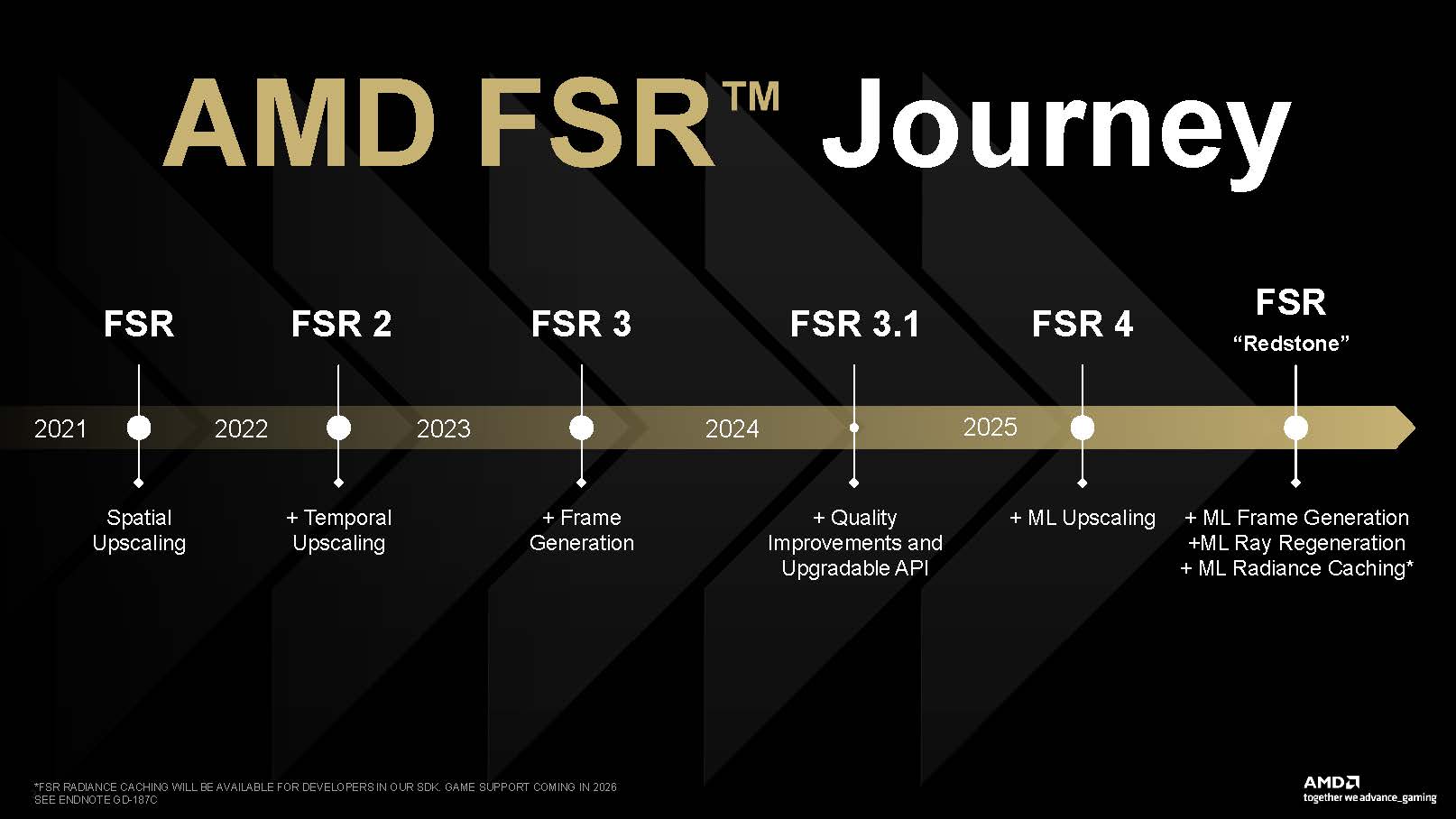
The beginning with FSR 1 and the attempt at broad support
When FSR 1 was released in 2021, the primary ambition was to provide an out-of-the-box upscaling technology that was not tied to specific hardware. AMD opted for a purely spatial upscaling method that did not use temporal data or neural models. This approach was deliberately kept simple to ensure broad compatibility with almost any GPU. The advantages were clear in terms of openness and ease of integration, but it quickly became apparent that the image quality in motion lagged behind the competition. By this time, NVIDIA had already introduced DLSS 2, which used temporal reconstruction methods and neural networks to deliver significantly more stable and sharper results.
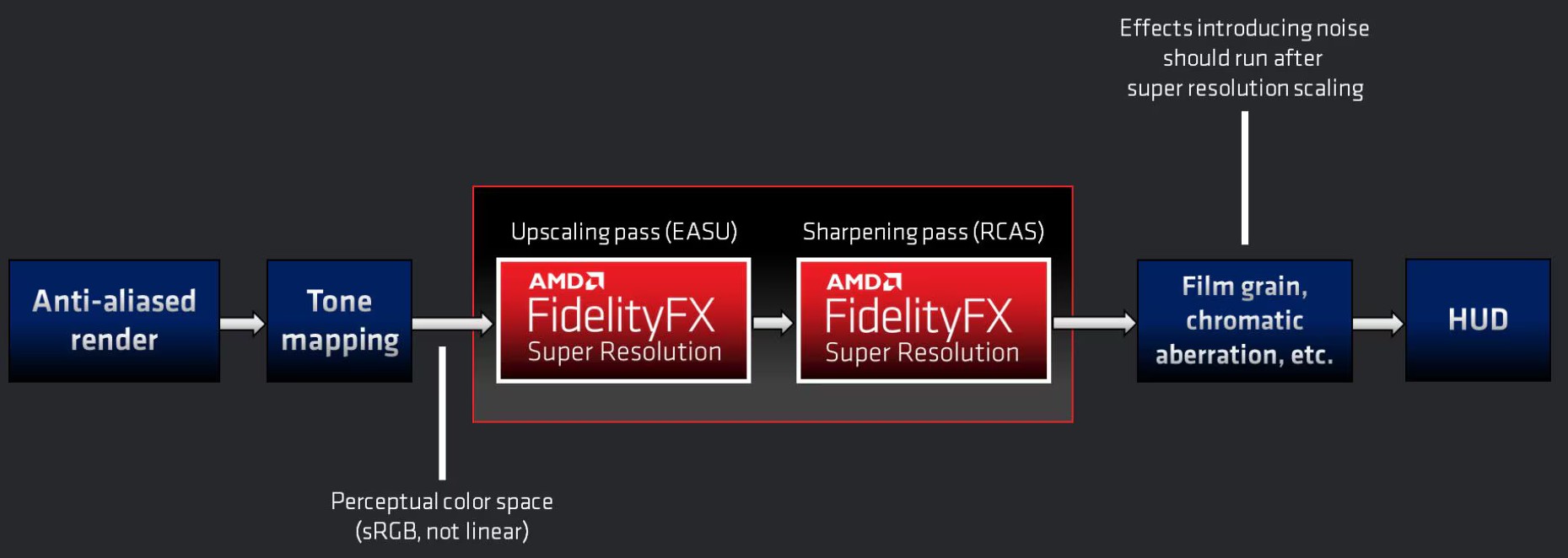
Although FSR 1 was convincing in static scenes, it suffered from visible artifacts such as flickering, blurred edges and temporal instabilities. Nevertheless, the release marked an important step, as AMD laid the foundation for an open and cross-platform rendering approach.
The leap with FSR 2 and closing the gap to DLSS
FSR 2 brought a fundamental change in 2022. Instead of a purely spatial upscaling method, AMD now used a fully-fledged temporal reconstruction model that had motion vectors, depth information and extensive internal filtering techniques. FSR 2 was the first real attempt to come closer to DLSS in terms of function and quality. The image quality improved significantly, especially for movements and fine structures. The integration required more effort on the part of the developers, but the technological step was necessary to keep pace with the competition.
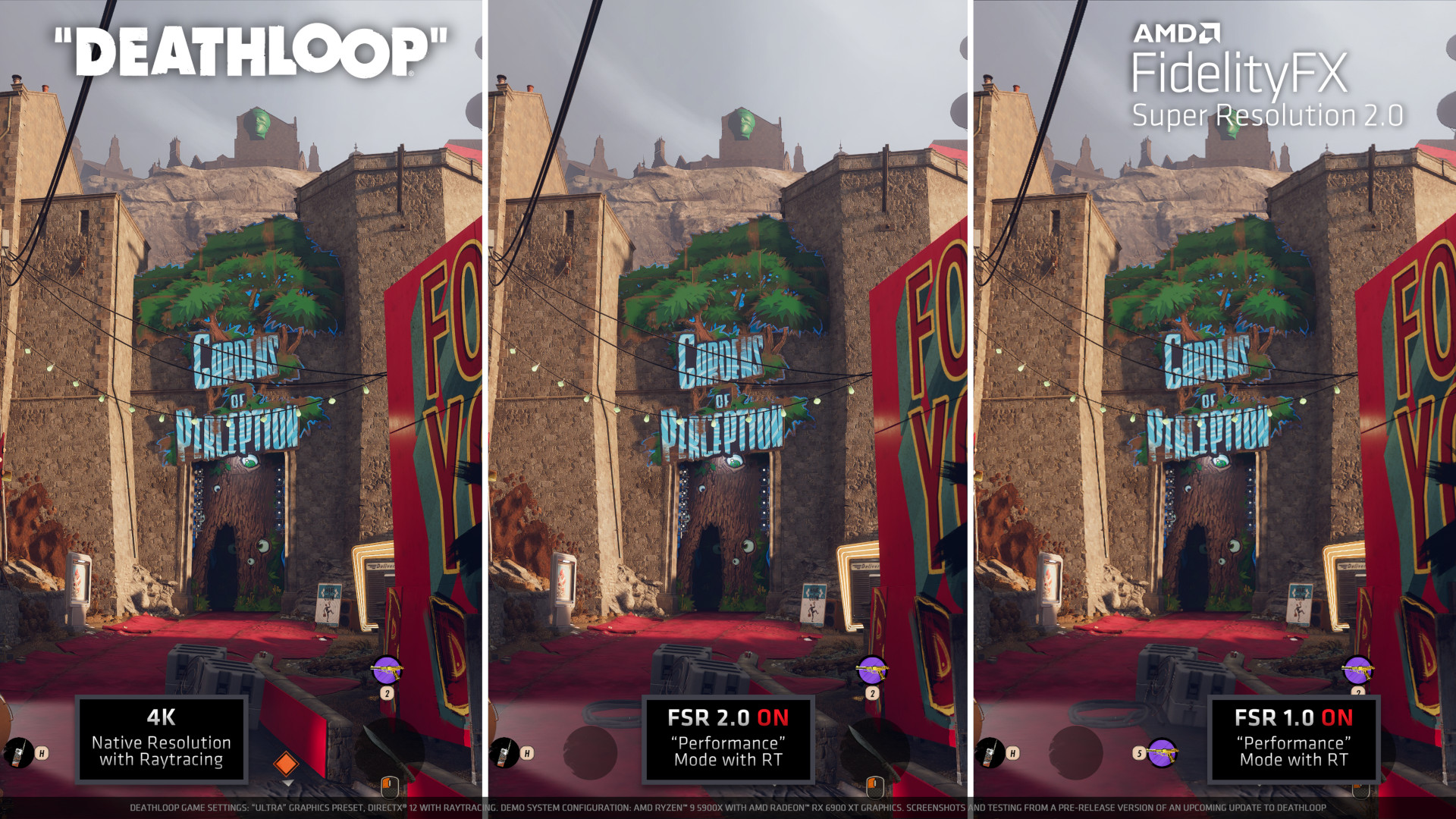
However, the key strength of FSR 2 remained its independence from dedicated AI hardware. This allowed it to be widely used on older GPUs, game consoles and competing graphics cards. At the same time, this approach represented a certain technical limit, as without neural models AMD was inevitably unable to achieve certain reconstruction details that DLSS already offered at the time thanks to its data-driven approach.
FSR 3 and the introduction of the frame generation
With FSR 3 in 2023, AMD significantly expanded the feature set and introduced a feature that NVIDIA itself had previously made prominent with DLSS 3. The frame generation made it possible to generate intermediate images synthetically in order to noticeably increase the effective frame rate. While NVIDIA used tensor cores for this, AMD once again opted for a generally usable approach that enabled frame generation to be largely hardware-agnostic.
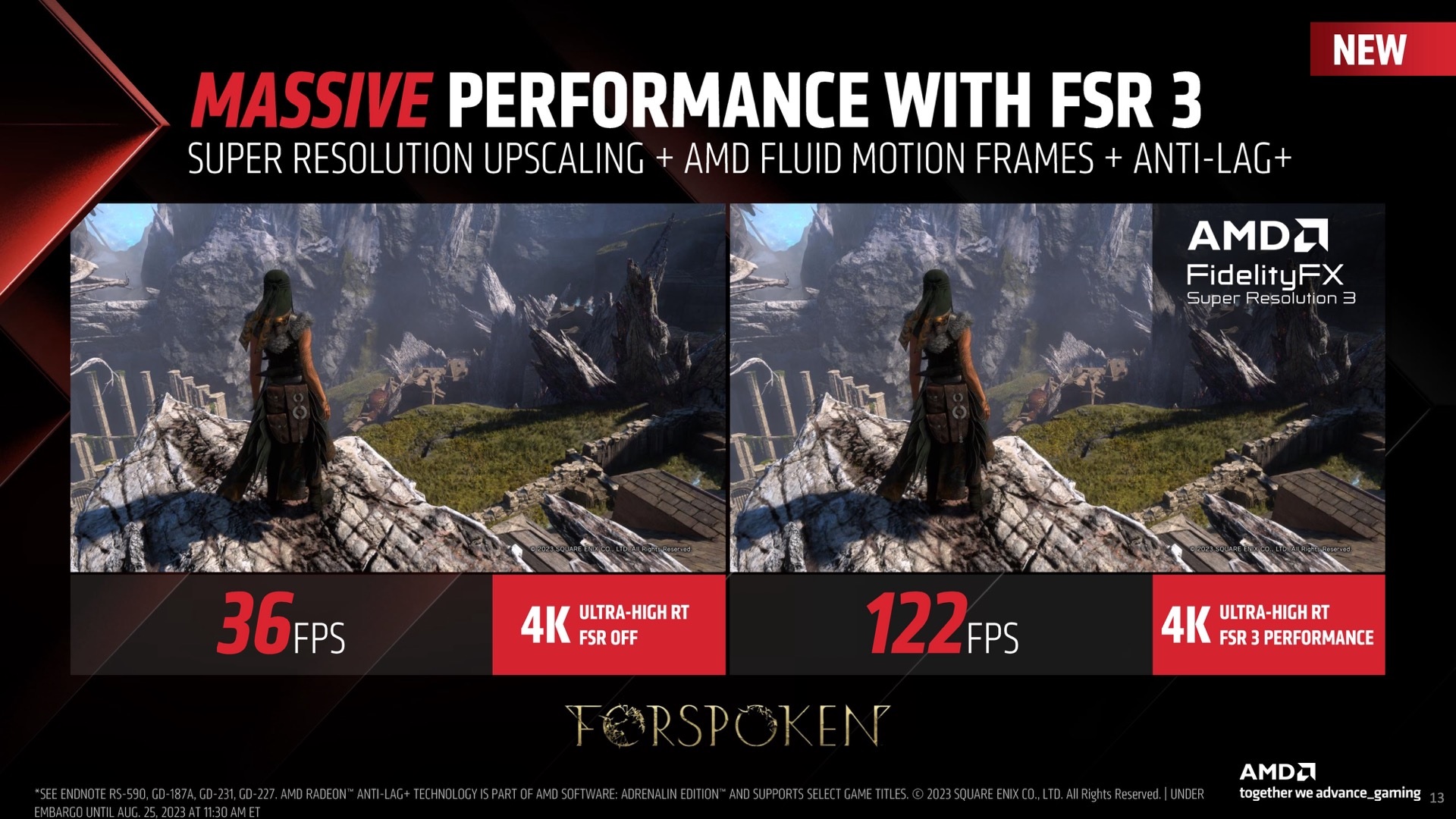
However, this openness led to a technically challenging problem. Without specialized AI hardware, the quality of frame generation is more dependent on the available shader resources. While initial implementations delivered satisfactory results, temporal stability was not constant in all titles. Nevertheless, FSR 3 represented an important step, as AMD now covered all the key functional areas of modern upscaling and frame generation technologies that previously only NVIDIA could offer.
FSR 3.1 and the technical refinement
Version 3.1 in 2024 focused primarily on quality improvements. AMD bundled various internal reconstruction stages, optimized integration into engines and introduced clearly structured interfaces to simplify integration for game developers. FSR 3.1 was less a technological leap than a consolidation of the architecture. The significance of this version was that AMD had now established a stable foundation on which ML-based modules could later be built. At the same time, the revised API meant that Redstone could later be docked onto existing FSR implementations as a consistent package.
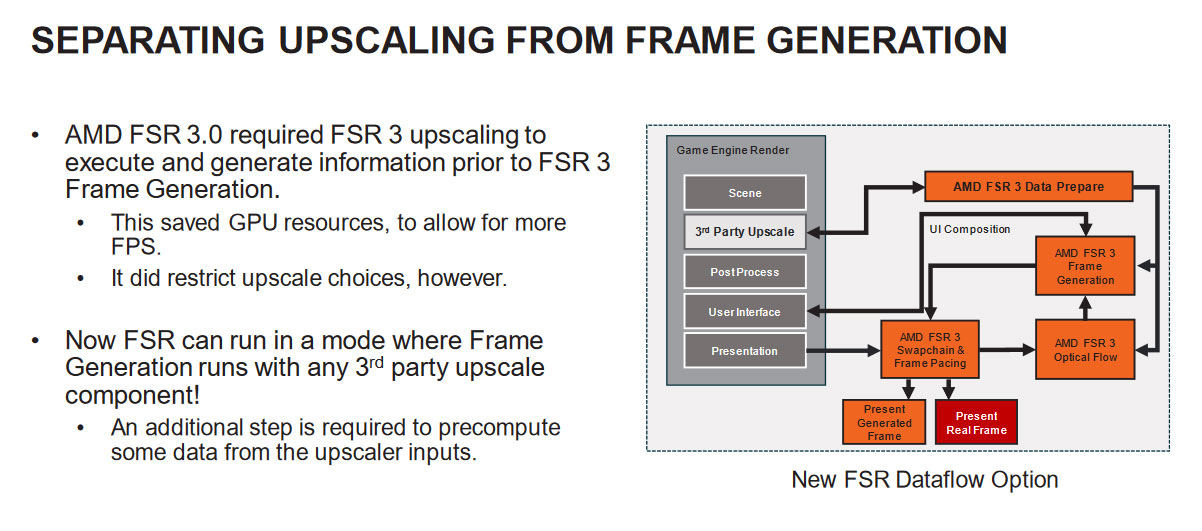
FSR 4 and the first step into the world of neural models
In 2025, FSR 4 marked the first real transition to the use of machine learning. For the first time, AMD trained an upscaling model on Instinct accelerators and used it in the rendering path in the form of an optimized inference module. This major shift marked the point at which AMD openly approached NVIDIA’s strategic approach for the first time, albeit still as part of an open implementation. FSR 4 showed noticeable progress in sharpness and detail rendering, especially at low resolutions. At the same time, it became clear that older GPUs without specialized AI units were suffering under additional load. This was a turning point, as it became clear that even open upscaling would eventually require specialized hardware in order to avoid efficiency problems with purely shader-based models.
Redstone as a logical consequence of technological development
With FSR Redstone, AMD is now uniting all essential ML technologies under a single roof. The architecture includes ML upscaling, ML frame generation, ML-based ray regeneration and ML-supported radiance caching. This means that AMD not only covers resolution and refresh rate, but also the reconstruction of light, material properties and global illumination for the first time. Redstone marks the point at which FSR can represent a fully ML-based render pipeline. Through this close integration of all modules, AMD provides a system that is functionally much closer to the vision of an end-to-end neural render path that NVIDIA has been pursuing for years with its RTX and DLSS strategy.
FSR 1 offered maximum openness but limited image quality.
FSR 2 closed the gap to DLSS, but without achieving the precision of an ML model.
FSR 3 introduced frame generation, but was limited by a lack of dedicated hardware.
FSR 3.1 stabilized the vision of a common render foundation.
FSR 4 enabled ML upscaling on AMD GPUs for the first time, albeit with performance losses on older generations.
FSR Redstone is the most complete approach and combines all important ML components in a coherent pipeline, albeit with limited hardware support.
The history of FSR is characterized by the claim to offer an open and accessible alternative to DLSS for many systems. While NVIDIA relied on specialized AI hardware from the outset and thus achieved qualitative advantages early on, AMD chose the path of broad support and gradual technological expansion. It was only with the introduction of ML upscaling and Redstone that AMD technically caught up with the type of image reconstruction that NVIDIA had already established.
FSR has thus evolved from a simple upscaler to a complete ML rendering pipeline. Redstone is the culmination of this evolution and shows that AMD is now ready to take the next steps towards AI-based rendering without abandoning the fundamental ideas of openness and ease of integration.

- 1 - Introduction, three looks back and one forward
- 2 - ML Radiance Caching in Detail
- 3 - ML Ray Regeneration in Detail
- 4 - ML Upscaling in Detail
- 5 - ML Frame Generation in Detail
- 6 - Aktiviation of FSR4 in game or in the Adrenaline drivers
- 7 - Benchmarks and Metrics
- 8 - Quality Comparison and Conclusion




















11 Antworten
Kommentar
Lade neue Kommentare
Urgestein
Urgestein
Veteran
1
1
Urgestein
1
Moderator
Veteran
Mitglied
Neuling
Alle Kommentare lesen unter igor´sLAB Community →